

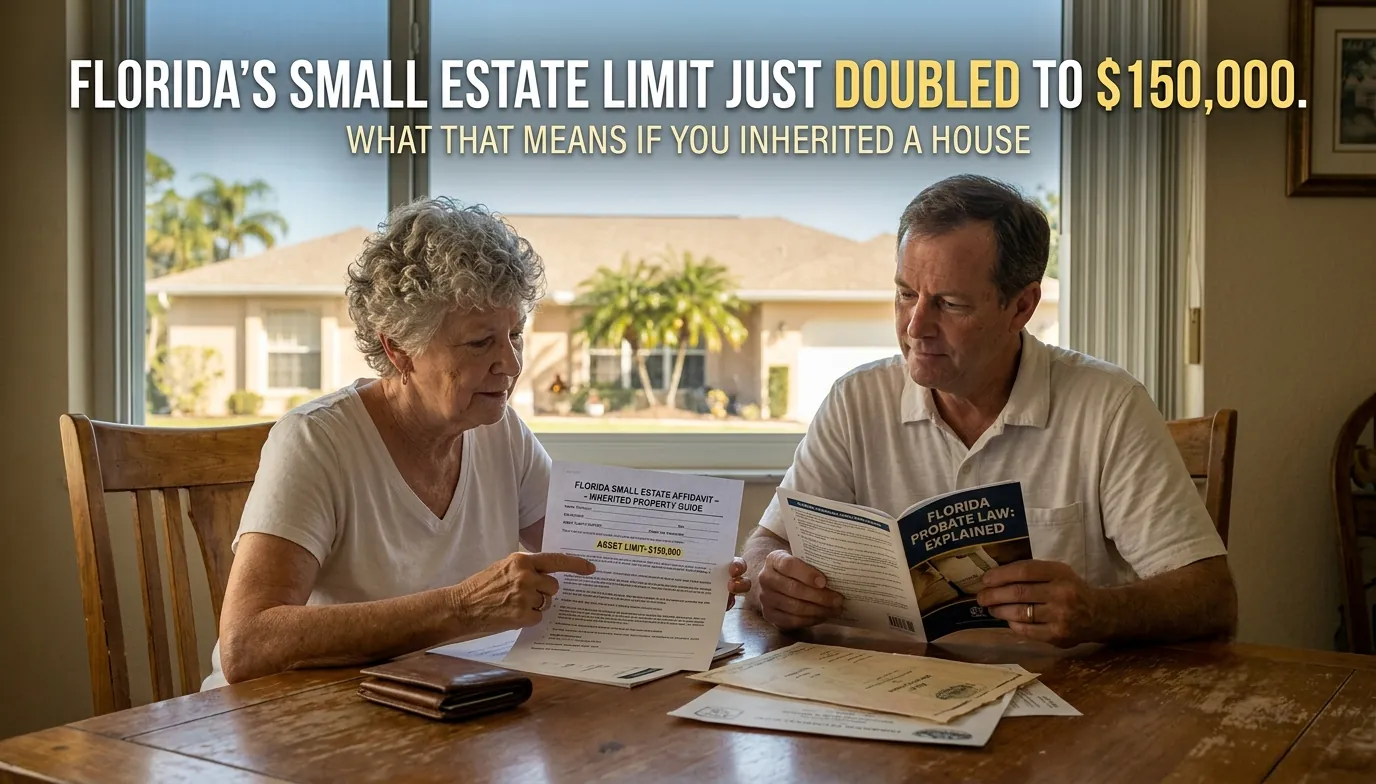
Her mother died in May. The house in Orange Park, a small savings account, a car, and a lot of paperwork nobody wanted to look at.
A probate attorney quoted her for formal administration because the estate was over the limit. She put the phone down and did not ring anybody else for four months.
The limit had changed on the first of July. Nobody had told her, and under the new one she was never over it in the first place.
I’m Kady. I help Florida homeowners through foreclosure, hardship, inherited property, illness, divorce, and all the things that arrive in a pile after somebody dies. I am a Realtor with Momentum Realty and I buy houses.
Inherited property is the single biggest category of call I get, and the same two misunderstandings come up nearly every time. People think probate always means a year and many thousands of dollars. And people think the house counts toward the limit.
Neither is reliably true, and a change in Florida law this summer made the first one less true than it has ever been.
I want to be careful here. I am not an attorney and I am not going to pretend this page replaces one. What I can do is explain, in plain words, the thing that just changed, how the value limit is actually measured, and the second route that has nothing to do with money at all, so that when you do speak to a lawyer you know what to ask for instead of accepting the first quote you are given.
CS/HB 1337, enacted as Chapter 2026-57 and signed on 29 April 2026, doubled the summary administration ceiling in Florida Statutes 735.201 from $75,000 to $150,000, effective 1 July 2026. Summary administration is the short, cheap form of Florida probate: no personal representative is appointed, no letters of administration are issued, and the court simply enters an order distributing the assets, often inside 60 to 90 days rather than the five to fifteen months formal administration commonly takes. Two things most families get wrong. The limit is measured on the estate value less property exempt from creditors’ claims, and a protected homestead passing to a spouse or heirs is generally excluded from that calculation, so the house frequently does not count at all. And there is a second route that ignores value entirely: if the person died more than two years ago, summary administration is available regardless of how much the estate is worth.
- The limit is $150,000 now, not $75,000. Nearly every page online is still wrong about this.
- Protected homestead is generally excluded from the value calculation, so the house often does not count.
- Two years since the death qualifies you regardless of value, by a completely separate route.
- Summary administration is fast. Often 60 to 90 days against five to fifteen months.
- No personal representative is appointed, which is its main limitation as well as why it is quick.
- Get a second opinion if you were quoted before July. The quote may have been right then and wrong now.
01What Actually Changed
One number, and it matters more than one number should.
Florida has, broadly, three ways of dealing with an estate. Formal administration, which is the full process with a personal representative, letters of administration, an inventory, a three month creditor publication and a timeline measured in many months. Summary administration, which is short. And disposition without administration, which is a very narrow route for tiny estates that is really about reimbursing funeral and final medical expenses.
Summary administration has a value gate, and that gate sat at $75,000 for years while Florida house prices and account balances went where they went. Which meant more and more ordinary families were pushed into formal administration purely by inflation.
CS/HB 1337, enacted as Chapter 2026-57 of the Laws of Florida and signed on 29 April 2026, doubled it. From 1 July 2026 the ceiling in section 735.201 is $150,000.
If you are reading this and thinking that sounds like a technical change that would not affect you, stay with me for the next section, because this is where families routinely talk themselves out of the cheap option.
02The House Probably Does Not Count
Here is the part that surprises nearly everybody.
The limit is not measured against everything your parent owned. It is measured against the value of the estate subject to administration, less the value of property exempt from the claims of creditors.
And in Florida, a protected homestead passing to a surviving spouse or to heirs is generally shielded from most creditors’ claims under the Florida Constitution. Which means its value is generally excluded from that calculation.
So think about what that does to the arithmetic. A mother in Orange Park with a house worth $290,000, an $18,000 savings account, a car and some furniture is not a $310,000 estate for this purpose. Strip out the protected homestead and the exempt personal property, and what is left may be well under $150,000, possibly well under $75,000.
The house, which everybody assumes is the thing that disqualifies them, is frequently the thing that is not counted.
This is the most time critical thing on this page. If the surviving spouse was not a borrower on the loan, ring the servicer now, say the words “non borrowing spouse,” and ask what certification they require and by when. Thirty days from a death is a terrible window to have to meet, which is exactly why families miss it while they are arranging a funeral. If you are the adult child helping, this is the one job to do before anything else. A HUD approved housing counselor can help and the service is free, on 800-569-4287.
Certain exempt personal property is also left out of the calculation, including household furnishings up to statutory limits and qualifying vehicles. Again, the detail matters and it is not something to eyeball.
The practical point I want you to take away is narrow and useful: do not disqualify yourself by adding up Zillow numbers. I have watched families spend thousands on formal administration they may not have needed because somebody looked at the house value, decided they were obviously over the limit, and never asked.
03The Two Year Route Nobody Mentions
There is a second door into summary administration and it has nothing to do with money.
If the person died more than two years ago, summary administration is available regardless of the value of the estate. A three million dollar estate qualifies on the same footing as a thirty thousand dollar one. CS/HB 1337 did not change this route at all.
The reason this exists is that Florida law generally bars claims against an estate two years after the date of death. Once that window has closed, the elaborate creditor machinery that formal administration is built around has much less work to do, so the short process becomes appropriate even for a large estate.
Now, who does this actually help? A very specific and very common person: the family that did nothing.
Dad died in 2022. Nobody probated the house because there was no mortgage and no urgency. The tax bill kept coming in his name. Then in 2026 somebody wants to sell, or refinance, or a sibling needs their share, and the family discovers that nobody can sign a deed because title is still in a dead man’s name.
That family has been quietly dreading an expensive formal administration for four years. They may well qualify for summary administration purely because of how long they waited. I am not recommending waiting, to be very clear, because waiting creates a dozen other problems including unpaid property taxes. But if you are already there, this route may be a far cheaper way out than you have been assuming.
If unpaid taxes are part of your situation, read cannot pay your Florida property taxes alongside this, because the tax deed clock does not pause for an estate and it is the one deadline in this whole area that can actually take the house.
04Summary Versus Formal, Side By Side
| Summary administration | Formal administration | |
|---|---|---|
| Who qualifies | Non exempt estate of $150,000 or less, or death more than two years ago | Everything else |
| Personal representative | None appointed, no letters of administration | Appointed, with letters of administration |
| How assets move | The court enters an order of summary administration distributing them directly | The personal representative administers and distributes |
| Inventory | Not required | Required |
| Creditor publication | Optional after the order, not required to distribute | Three month publication period |
| Typical timeline | Often 60 to 90 days | Commonly five to fifteen months, sometimes longer |
| Relative cost | Substantially cheaper | Substantially more |
| Power to act | Limited, no representative to deal with banks, insurers or servicers | Full, the representative can sue, collect and pay debts |
Who can start it: a person with an interest in the estate, meaning a beneficiary, a person nominated as personal representative, or an heir at law. If there is a surviving spouse, they must sign. Other beneficiaries and heirs generally should sign too, unless they are receiving their full share. The petition needs the death certificate, the original will if there is one, the assets, the homestead position, known creditors and the proposed distribution, and the petitioner has to represent to the court that creditors’ claims are barred or that provision for payment has been made.
Which is a lot of words to say: it is simple relative to formal administration, and it is not something most people should attempt alone with a house involved. A probate attorney doing a summary administration is dramatically cheaper than one doing a formal administration, and that difference is the whole point of this article.
05What Summary Administration Cannot Do
I would be doing you a disservice if I only sold you the upside, so here is the honest limitation.
Because no personal representative is appointed, there is nobody with authority to act on behalf of the estate. No letters of administration means no document to hand a bank, an insurer or a mortgage servicer that says “I am authorised to deal with this.”
That matters in specific situations, and some of them are ones I deal with constantly.
If there is a mortgage in default, somebody usually needs to be able to talk to the servicer with authority, request a payoff, apply for loss mitigation or negotiate. That is far harder without a personal representative.
If there is a reverse mortgage, the servicer’s clock runs fast and you will be dealing with them constantly. I have written about that in mom had a reverse mortgage, what happens to the house now, and it is a situation where authority to act is worth a great deal.
If the estate owes real money, summary administration has no mechanism for a representative to pay debts from estate assets in an orderly way. It is not designed for an indebted estate.
If there is a dispute, between siblings, with a creditor, about the will, you want the structure of formal administration and a representative with standing.
If anything needs collecting or suing over, an unpaid insurance claim, a debt owed to the deceased, a lawsuit, there is nobody to do it.
And one practical note from the selling side. Although creditor publication is not required in order to distribute, title companies sometimes want to see it before they will insure a sale. If selling is the plan, raise that with the attorney at the start rather than discovering it a week before closing.
06The Open Question About Earlier Deaths
I am including this because I would rather tell you about an unsettled point than pretend everything is tidy.
If your parent died before 1 July 2026, does the new $150,000 ceiling apply to you?
Florida probate attorneys are not entirely of one mind on this. Some read the enrolled bill as containing nothing that limits the new threshold to deaths occurring after the effective date, and reason that because eligibility is assessed when the court considers the petition, an estate of someone who died earlier should be able to use the new cap for a petition filed on or after 1 July 2026. Others are reading it more conservatively and treating deaths before that date as remaining under the old $75,000 limit.
I am not qualified to resolve that and I am not going to pretend otherwise. What I will say is this. If your person died before July and the estate falls between $75,000 and $150,000 of non exempt value, that is a specific question worth putting to a Florida probate attorney in those words, because the answer is worth a great deal of money to you and a general phone enquiry will not surface it.
And note what sits underneath that argument anyway: if the death was more than two years ago, you are on the two year route and the dollar figure does not matter at all.
07What This Changes If You Want To Sell
Most people who ring me about an inherited house are not trying to understand probate for its own sake. They want to know when they can sell, and what it is going to cost them to get there.
Three things this change does for you.
It can shorten the wait dramatically. Sixty to ninety days against five to fifteen months is not a small difference when siblings live in three states, nobody wants to keep paying the insurance, and the house is sitting empty through a Florida summer. A vacant Florida house deteriorates faster than people expect, insurers treat vacancy differently, and an empty house is also where the unauthorized occupant problem starts.
It can leave meaningfully more money in the estate. The difference between the two processes in legal fees is not trivial, and it comes out of what the heirs receive.
It does not change what the house is worth, or what it needs. The probate route determines when and how you can convey title. It does nothing about the roof, the insurance, the taxes or the market. Those are separate problems and they are usually the ones that decide whether you list it or sell it as is.
When somebody asks me whether to wait and list traditionally or sell as is, the probate route is one input among several. The others are what the house needs, whether the heirs can agree, whether anybody can carry the holding costs in the meantime, and how fast people need the money. I will walk through that honestly with anybody, including when the answer is that they should list it with a traditional agent and I should get out of the way. I have set out the as is route in selling a house as is for cash in Florida, and the wider first steps in inherited a house in Florida, here is what to do first.
What people believe
The house is worth $290,000, so we are obviously over the limit and need full probate.
What is true
Protected homestead is generally excluded from the calculation. The house frequently does not count at all.
What people believe
We waited four years, so it is going to be even more expensive now.
What is true
Death more than two years ago opens summary administration regardless of value. Waiting created other problems, but not that one.
What people believe
Summary administration is the cheap option, so it must be the right one.
What is true
With no personal representative there is nobody with authority to deal with servicers, banks or disputes. For an indebted or contested estate that is a real problem.
08Probate, Florida Foreclosure, and The Clock
Pull the parcel on the county property appraiser site
Note the owner of record, the assessed value, and whether a homestead exemption is shown. That exemption is an indicator of homestead status, not a determination, but it tells you which conversation you are having.
Call the county tax collector with the parcel number
Ask which tax years are unpaid, whether any tax certificates exist, and whether a tax deed application has been filed. You do not need to be on the deed to ask. This is the only clock in the whole situation that can actually take the house, and it does not wait for probate.
Write down the estate, honestly
Every asset and roughly what it is worth. Mark the house separately. Note any mortgage or reverse mortgage, any known debts, and the date of death. Note who the heirs are and whether there is a surviving spouse and a will. That single page is what an attorney needs to answer your question in one call.
Ask a Florida probate attorney the specific question
Not “how much is probate.” Ask: “Does this estate qualify for summary administration under the $150,000 threshold once protected homestead and exempt property are excluded, or under the two year rule?” That question gets you a useful answer. The general one gets you a general quote.
Get a second opinion
A quote given before 1 July 2026 was based on a $75,000 ceiling. It may have been entirely correct at the time and wrong now. That is not a reason to distrust the attorney, it is a reason to ring back.
Keep insurance and taxes current while you sort it out
A lapse while everybody waits for probate creates an entirely new problem on top of the one you are solving. Vacant Florida houses are a serious exposure and insurers treat vacancy differently. Somebody needs to be looking after the property.
The woman from Orange Park rang a second attorney in September.
Once the homestead came out of the calculation, what was left was nowhere near the new ceiling. She was never anywhere near it. She had sat on it for four months because of a number that had changed six weeks after she heard it.
She listed the house in October with a traditional agent, which is what I told her to do, because it was in good condition and she had the time.
I did not make a penny and I do not mind at all. Four months of somebody’s life is worth more than a deal.
If several siblings are involved
The legal route is usually the easy part. The hard part is that one of you wants to sell, one wants to keep it, and one has not answered a text since the funeral. Three things that help. Decide early whether anybody genuinely intends to buy the others out, and get a real valuation rather than arguing about a Zillow figure. Agree in writing how whoever pays the taxes, the insurance and the lawn gets accounted for at the end, because that argument has cost families more than the probate ever did. And if the deadlock is real, understand that Florida has a court process for forcing the sale of jointly owned property, which nobody enjoys and which is best avoided by talking now.
Tell me the county, roughly what the estate holds and when the person died, and I will help you work out which questions to ask, even when the answer is a lawyer and a traditional agent.
Questions People Ask Me
What is Florida’s summary administration limit now?
$150,000, from 1 July 2026. CS/HB 1337, enacted as Chapter 2026-57 of the Laws of Florida and signed on 29 April 2026, doubled the ceiling in Florida Statutes 735.201 from $75,000. The figure is measured against the value of the estate subject to administration, less the value of property exempt from the claims of creditors, which is why protected homestead is generally excluded. Most pages online still quote the old $75,000 figure.
Does the house count toward the $150,000?
Often not. The threshold is measured on the estate value less property exempt from creditors’ claims, and a protected homestead passing to a surviving spouse or to heirs is generally shielded from most creditors’ claims under the Florida Constitution, so its value is generally excluded. Certain exempt personal property, such as household furnishings up to statutory limits and qualifying vehicles, is also excluded. Whether a particular property is protected homestead is a legal determination, not something to assume from the fact that somebody lived there.
What is summary administration?
It is the short form of Florida probate. No personal representative is appointed and no letters of administration are issued. Instead the court enters an order of summary administration that distributes the assets directly. There is no required inventory and no mandatory three month creditor publication, which is why it commonly completes in 60 to 90 days rather than the five to fifteen months formal administration often takes, and why it costs substantially less.
Can I use summary administration if the estate is worth more than $150,000?
Yes, by a separate route, if the person died more than two years ago. That route ignores value entirely, so an estate of any size qualifies. It exists because Florida law generally bars claims against an estate two years after the date of death, so the creditor machinery that formal administration is built around has much less to do. CS/HB 1337 left this route unchanged.
My parent died before 1 July 2026. Does the new limit apply to me?
This is genuinely unsettled among Florida probate attorneys. Some read the enrolled bill as containing nothing limiting the new threshold to deaths after the effective date, and reason that since eligibility is assessed when the court considers the petition, an earlier death should be able to use the new cap for a petition filed on or after 1 July 2026. Others are treating earlier deaths as remaining under the old limit. If your estate falls between $75,000 and $150,000 of non exempt value, put that exact question to a Florida probate attorney, because the answer is worth real money.
Who can file a petition for summary administration?
A person with an interest in the estate, which means a beneficiary, a person nominated as personal representative, or an heir at law. If there is a surviving spouse, they must sign the petition. Other beneficiaries and heirs generally should sign as well, unless they will receive their full share. The petition is filed with the death certificate, the original will if there is one, details of the assets, the homestead position, known creditors and the proposed distribution.
How long does summary administration take in Florida?
Commonly 60 to 90 days, and sometimes a matter of weeks, compared with five to fifteen months or longer for formal administration. The speed comes from the fact that no personal representative is appointed, no inventory is required, and the mandatory three month creditor publication of formal administration does not apply. The actual timeline depends on your county’s court, whether everyone signs promptly, and whether the homestead position needs determining.
What are the downsides of summary administration?
Because no personal representative is appointed, nobody has authority to act for the estate. That matters if there is a mortgage in default and somebody needs to deal with the servicer, if there is a reverse mortgage with a fast moving clock, if the estate genuinely owes money and debts need paying in an orderly way, if there is a dispute between heirs or with a creditor, or if something needs collecting or suing over. It is not designed for an indebted or contested estate.
Do I have to publish a notice to creditors?
Publication is not required in order to distribute under a summary administration, which is one of the reasons it is quick. The petitioner does have to give notice to known creditors and must represent to the court that claims are barred or that provision for payment has been made. After the order is entered, the petitioner may publish, and unknown creditors then have a limited time to file. Title companies sometimes want to see publication before insuring a sale, so raise it early if selling is the plan.
Can I sell the house during or after summary administration?
The order of summary administration is what moves title to the people entitled to it, and once title is clear in their names they can convey it. Exactly how that plays out depends on whether the property is protected homestead, whether an order determining homestead is needed, and what your title company requires. Raise selling with the attorney at the very start, not at the end, because the sequence can be arranged to suit a sale rather than against it.
Do I need a lawyer for this?
With a house involved, yes, and I say that as somebody with no stake in it. Summary administration is simple relative to formal administration but it is still a court proceeding with a petition, notice requirements, homestead questions and a distribution order that your title company will scrutinise. The relevant comparison is not lawyer versus no lawyer, it is a few hours of a probate attorney’s time on a summary administration against many more hours on a formal one. That gap is the whole reason this article exists.
What is disposition without administration?
It is a third and much narrower route, for very small estates, aimed at reimbursing people who paid final medical and funeral expenses out of their own pocket. It is not a route for dealing with real estate and it is not an alternative to summary administration for a family with a house. If somebody has mentioned it to you in connection with a property, get that checked, because it is probably not the right mechanism.
Nobody probated my father’s house and he died in 2021. Where do we stand?
Better than you probably fear on the probate side, because a death more than two years ago opens summary administration regardless of the estate’s value. Worse than you may realise on everything else, because title is still in his name so nobody can convey or refinance, and the property tax bill has been arriving addressed to him. Call the county tax collector with the parcel number today and find out whether certificates exist or a tax deed application has been filed, then take that information to a probate attorney.
What if my siblings and I cannot agree?
Then the legal route is not your real problem and you should deal with the disagreement first. Get a genuine valuation rather than arguing over an online estimate, decide early whether anybody actually intends and is able to buy the others out, and agree in writing how whoever is paying the taxes, insurance and upkeep is accounted for at the end. Florida does have a court process for forcing the sale of jointly owned property, which is slow, expensive and unpleasant, and which is best treated as the reason to reach agreement rather than as a plan.
The house needs a lot of work and nobody can afford to fix it. What then?
That is a separate question from probate and it is usually the one that actually decides what happens. Sort the legal route so title can be conveyed, then look honestly at the numbers: what the house is worth as is, what it would cost to get it listable, who is carrying the insurance and taxes in the meantime, and how fast the heirs need the money. Selling as is to a cash buyer is one answer and listing with an agent is another, and which is right depends on those figures rather than on anybody’s preference.
Keep reading
A gentle note: I am a Florida Realtor with Momentum Realty and a home buyer, not an attorney, an accountant, or a probate professional, and this is general information rather than advice about your estate. Probate is a court proceeding and the outcome turns on the specific deed, the will, who survives, how property was titled and what the estate owes, none of which can be assessed from a web page. Statutory references here reflect publicly available information as of October 2026, including Florida Statutes section 735.201 as amended by CS/HB 1337, Chapter 2026-57, Laws of Florida, effective 1 July 2026. Whether the new threshold applies to deaths occurring before that date is an open question among Florida practitioners. Please consult a licensed Florida probate attorney about your own situation before relying on anything here.
Written by Kady Andreoli, founder of Helping Hand Home Solutions FL and a Realtor with Momentum Realty. Helping Florida homeowners explore every available option, from stopping foreclosure to selling on their own terms. Guidance without judgment, and people before profit. 904-400-2131 · kady@helpinghandhomesfl.com