

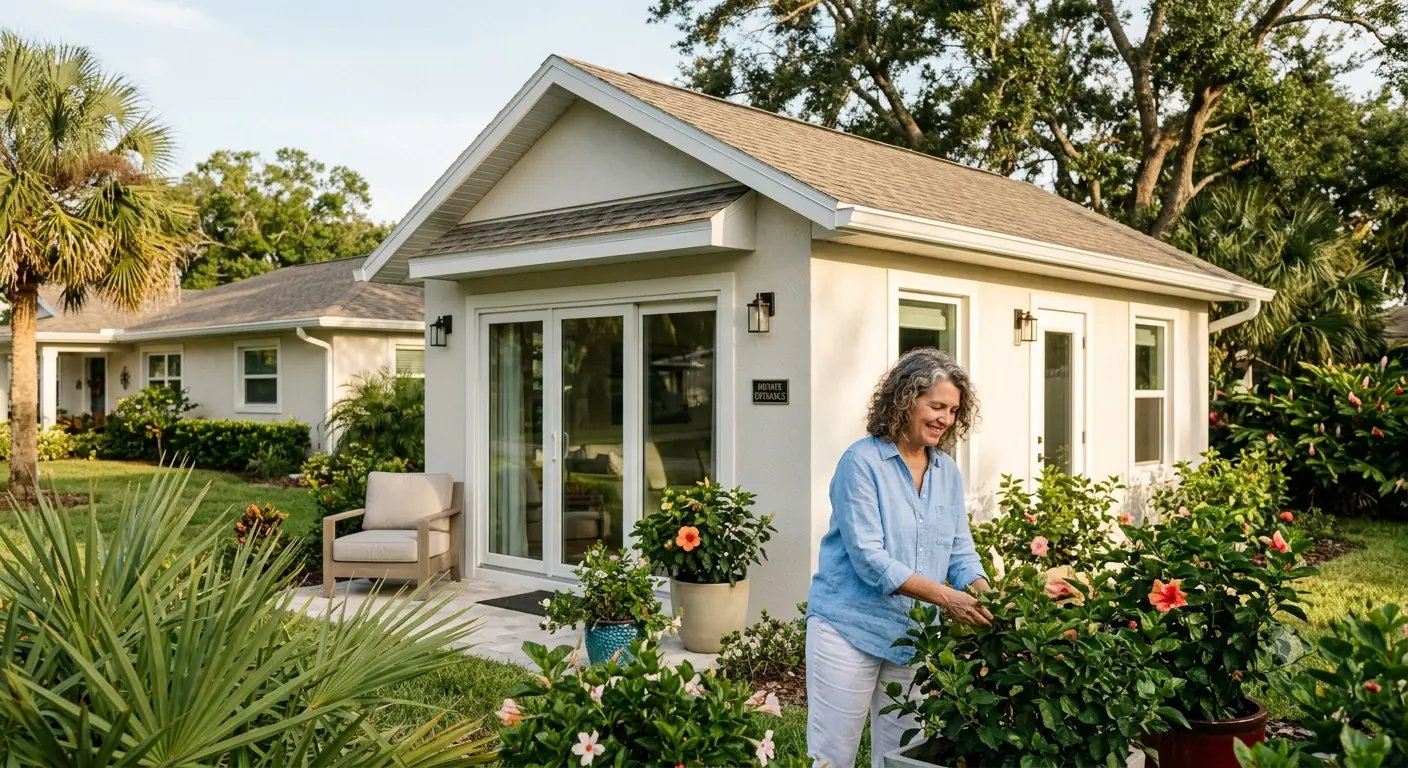
We just finished a house out in Glen St. Mary. Four bedrooms, three baths, fifteen acres, and a mother in law suite.
Rain held up the outside work for nearly two weeks and I was ready to lose my mind about it. But just look at her now.
And out of everything in that house, the room people keep asking me about is the suite.
I’m Kady. I help Florida homeowners through foreclosure, hardship, inherited property, illness, divorce, and I buy and renovate houses, which is how I ended up spending two rainy weeks staring at a suite in Baker County wondering whether anyone would care about it.
They care enormously. That suite is the reason that house will sell, and it is the single most requested feature I hear from Florida buyers right now. Multigenerational living is not a trend here, it is just arithmetic. Parents retire to Florida. Adult children move home. Somebody needs care and nobody can afford two mortgages.
So homeowners are asking two questions, and they are being given bad answers to both. Can I build one. And does it add value.
I am going to answer both properly, including the part almost nobody mentions, which is that renting out a mother in law suite can cost you a slice of your homestead exemption and bring a bill for back taxes with interest. That one has taken people by real surprise, and because an unpayable tax bill is one of the ways people lose paid off houses in this state, it sits squarely in my lane.
There is no statewide right to build an accessory dwelling unit in Florida. A bill to create one moved through the 2026 session and did not become law. The statute that still governs, Florida Statutes section 163.31771, says local governments may adopt an ordinance allowing ADUs, and where they have, the permit application generally requires an affidavit that the unit will be rented at an affordable rate. So the answer to “can I build one” is a county and city answer, not a Tallahassee answer. On value, a legal and permitted suite is one of the strongest features a Florida house can have, and an unpermitted one is a liability that follows you into appraisal, financing, insurance and closing. And if you rent it out, be aware that renting a portion of your homestead can mean losing the homestead exemption on that portion, along with its Save Our Homes cap, with back taxes, penalties and interest available to the property appraiser.
- No statewide ADU right exists in Florida. Anyone telling you a 2026 law gave you one is wrong.
- Your county and city decide, and two neighbouring counties can give you completely opposite answers.
- Permitted or not permitted is the whole ballgame for value, financing, insurance and resale.
- Renting it can cost you part of your homestead exemption, including the Save Our Homes cap on that portion.
- A second kitchen is the line most local codes care about, because it is what turns a suite into a dwelling unit.
- Family living there rent free is a different situation from a tenant paying rent. The tax consequences are not the same.
01What Counts As a Mother In Law Suite
Half the confusion in this topic is that five different things share one nickname, and the local code treats them very differently. Before you ask anybody anything, work out which of these you mean.
| What you have | What it usually means | Why it matters |
|---|---|---|
| In law bedroom suite | Bedroom, private bath, sometimes a sitting area, inside the main house, no kitchen | Almost always just a bedroom and bath to the code. The easiest thing to build and the least regulated |
| Attached suite with private entrance | Same, plus its own exterior door, often a wet bar or kitchenette | Starts to look like a dwelling unit. Whether it crosses the line usually turns on the kitchen |
| Garage or carport conversion | Living space built inside an existing attached or detached garage | Triggers parking requirements, egress, insulation and permit history questions. Very commonly done without permits |
| Detached ADU or guest house | A separate small building with its own kitchen, bath and entrance | This is the true accessory dwelling unit, and the one that needs your local ordinance to allow it at all |
| Duplex conversion | The house split into two fully independent units with separate utilities | Now a density and zoning question, not an ADU question. Usually not permitted in single family zoning |
Here is the practical rule I use when I walk a house. The second kitchen is the line. A bedroom and a bathroom with a private door is a suite. Add a stove, a sink and a full refrigerator, and most local codes start looking at it as a second dwelling unit, which brings in zoning, density, minimum lot size, setbacks, parking, utility connections and sometimes impact fees.
That is why so many Florida suites are built with a microwave, a bar sink and a mini fridge and no range. It is not a design choice. It is a code choice, and whether it works depends on how your particular jurisdiction defines a dwelling unit. Some count a sink plus a cooking appliance. Some only count a permanently installed range. You have to read your own code or ask your own planning department.
02The 2026 Law That Did Not Pass
I need to clear something up, because I have now read three separate articles and two agent newsletters this year telling Florida homeowners that a new law gives them the right to build an accessory dwelling unit. It does not, because that bill did not make it.
During the 2026 session a bill moved through the Florida Legislature that would have created a statewide framework requiring local governments to allow accessory dwelling units in single family zoning. It had momentum. It got a lot of coverage, which is exactly why so many people now believe it is the law. It died in the House in March 2026 and never became law.
Separately, a housing bill did pass that session and was enacted into Florida law effective 1 July 2026. That one amends the Live Local Act framework, which is about affordable housing development, preemption of local approval for qualifying multifamily projects, and related land use provisions. It is a meaningful piece of legislation and it has nothing to do with your right to put a suite behind your house.
I think the two got blended together in the reporting, and the result is homeowners calling their counties expecting a yes and being told no.
Two things follow from that statute, and both surprise people.
The first is that permission is local and optional. Your county or municipality may have adopted an ADU ordinance. It may have adopted a narrow one that applies to a few zoning districts. It may have adopted none at all, in which case a detached ADU is simply not an allowed use no matter how much land you have.
The second is the affordability affidavit, and this is the one that catches investors. Where a local ordinance has been adopted under this statute, the application process generally requires you to affirm that the unit will be rented affordably to extremely low, very low, low or moderate income households. People who are imagining a nightly rental or a market rate apartment in the back yard need to read their own county’s ordinance very carefully before they spend money, because the statutory framework the ordinance sits on was written to produce affordable housing, not short term rental inventory.
None of which applies to Grandma living in the back. Housing a family member is not renting. But if your plan involves rent, the affidavit is not a formality.
03So Who Actually Decides
Your county and your city. And I mean that literally, because in Florida the answers vary wildly between places fifteen minutes apart. I have seen one side of a county line allow a detached eight hundred square foot ADU as of right and the other side allow nothing at all.
Here is the order I would do it in, and all of it is free.
Find your zoning district and your parcel
Pull your property up on your county property appraiser’s site. Note the zoning designation, the parcel size, whether you are inside city limits or in unincorporated county, and your current land use. Inside or outside city limits changes who you are asking.
Search your land development code for the exact words
Search your county or city code for “accessory dwelling unit,” “guest house,” “garage apartment” and “accessory living quarters.” Those four phrases find it in most Florida codes. You are looking for whether it is permitted, in which districts, and under what conditions.
Note the conditions, not just the yes
A yes almost always comes with limits. Maximum square footage, often a percentage of the main house. Minimum lot size. Setbacks. Owner occupancy of one of the two units. An extra parking space. A rule that it cannot have its own driveway. Any one of these can kill a plan.
Call the planning and zoning counter, not the permit counter
Permits tell you how to build what is allowed. Planning tells you what is allowed. Give them the parcel number and ask plainly: is an accessory dwelling unit a permitted use on this parcel, and if so under what section. Ask for the code section number so you can read it yourself.
Check your HOA and any deed restrictions
Your county can say yes and your HOA can still say no. Covenants routinely prohibit second dwellings, separate entrances, and any rental of part of a lot. Read the declaration, not the website. A county approval does not override a recorded covenant.
Septic, well and utility capacity
On acreage this is usually the binding constraint rather than zoning. A second dwelling unit means additional wastewater load, and your existing septic system was sized for the house you have. A health department evaluation comes before the architect, not after.
That whole sequence costs nothing and takes an afternoon. I would do all six before I spoke to a single contractor, because the most expensive version of this is finding out at inspection that the thing you built was never an allowed use.
04The Homestead Trap
Now the part nobody writes about, and the reason this article exists on a foreclosure help website rather than a remodelling blog.
In Florida, your homestead exemption attaches to the property you actually live in as your permanent residence. When you rent out a portion of that property, Florida law treats that portion as no longer being used as your homestead. The property appraiser can apportion the exemption, and you lose it on the rented share.
That is not a technicality. Losing the exemption on part of your home means two things happen at once, and the second is worse than the first.
You lose the exemption dollars on that share. And you lose the Save Our Homes assessment cap on that share, which is the three percent annual limit on how fast your assessed value can rise. If you have owned your home a long time, that cap is probably worth far more to you than the exemption itself, because it has been holding your assessed value far below market for years. Unwinding it on part of the house can reset that portion toward current market value.
And this is not theoretical. Florida courts have upheld the back assessment of the rented portion of a homestead, including a case that worked its way up to the Florida Supreme Court in which a homeowner who had rented out a share of his home lost the exemption on that share and was assessed roughly seven thousand dollars in back taxes, penalties and interest covering a run of years. Property appraisers can look backward, not just forward.
If your mother lives in the suite and pays you nothing, you are housing a family member in your own home and there is no rental. If somebody pays you rent for exclusive use of a portion of the property, that is a rental and the apportionment question is live. Renting out the entire dwelling is a separate and stricter matter under Florida law and can be treated as abandoning the homestead altogether. If money is going to change hands in any direction, ask your county property appraiser’s office in writing before you start, and ask a Florida CPA or attorney about your specific arrangement. Getting that answer in advance costs a phone call. Getting it afterwards costs years of back taxes.
I am not telling you not to rent it. Plenty of people need that income and the arithmetic still works even after the tax hit. I am telling you to do that arithmetic before the first rent cheque, with the property appraiser’s own guidance in hand, instead of discovering it on a TRIM notice three years later.
And if you are already in that position, with a tax bill you did not expect on a house you thought was safe, that is a solvable problem and not a reason to panic. Florida has a homestead tax deferral for qualifying homeowners, which I have written about in detail in what is Form DR-570. Deferral is not forgiveness, but it buys time, and time is usually what people actually need.
05Does It Add Value, Honestly
Yes, and with conditions, and I want to be straight about the conditions because this is where homeowners overestimate their return.
Strongest effect
It widens your buyer pool
This is the real value and it is larger than most people think. Florida has an enormous population of buyers looking after ageing parents, adult children who moved home, or both at once. A suite moves your house from “another three bedroom” to the only house on their list. Competition is what moves price.
works whether permitted or not, but see below
Depends entirely on paperwork
Appraised value
An appraiser gives weight to what is legal and permitted. A permitted ADU with a certificate of occupancy can be valued as a genuine second unit. An unpermitted conversion is often treated as unfinished space, excluded from the gross living area, or flagged as a non conforming use that affects the whole report.
permits are the difference
Only if legal
Rental income in financing
Some conventional guidelines now allow a portion of documented rental income from an accessory unit on a primary residence to be considered in qualifying. The condition is always that the unit is legal and permitted and allowed by zoning. An unpermitted suite produces income no underwriter will count.
ask your lender for their specific rule
The honest caveat
You rarely recover the full build cost
A detached ADU in Florida is real construction with a foundation, utilities, impact fees and a Florida windstorm rated roof. The cost frequently exceeds the measurable appraised lift. Build it because you need it and the family arrangement is worth it, and treat the resale appeal as a bonus rather than the business case.
build for use, not for flip
Let me put that more plainly. If you are asking whether to spend a hundred and twenty thousand dollars building a detached ADU purely to raise your sale price, my answer is usually no. If you are asking whether the suite you already have is one of the best features of your house, my answer is almost always yes.
And if you are asking whether to bring an unpermitted conversion into compliance before selling, that one is worth running the numbers on properly, because the gap between “bonus room” and “legal second unit” on an appraisal is frequently larger than the cost of the permits.
06Unpermitted Suites and What They Do To a Sale
I buy houses, so I see a lot of these. Somebody enclosed the garage in 2011. Somebody’s brother in law ran the plumbing. There is a shower in there that no inspector has ever seen. And the owner has lived with it happily for fourteen years and is genuinely shocked when it becomes a problem at closing.
Here is what actually goes wrong, in the order it usually goes wrong.
The appraisal. Appraisers generally cannot count unpermitted square footage as gross living area, and many will not give it meaningful value. So the room you spent thirty thousand dollars on may contribute very little to the number the lender relies on.
The loan. If the appraiser flags the conversion as a non conforming or illegal use, the underwriter may condition the loan on the space being restored to its permitted condition, or decline. That is a buyer’s loan falling through on your contract, usually late.
The insurance. A carrier that discovers unpermitted living space, altered electrical or an unpermitted second kitchen can decline to write the policy, write it with exclusions, or deny a claim later on. And without insurance the buyer cannot get the mortgage, which takes you back to the previous paragraph.
The disclosure. Florida law requires a seller to disclose known facts materially affecting the value of the property that are not readily observable. An unpermitted addition is squarely in that territory. Hoping nobody notices is not a strategy, it is a lawsuit with a delay built in.
The county. Code enforcement does not expire. An open or discovered violation can mean permits after the fact, engineering reports, opening up finished walls for inspection, fines, or an order to remove the work.
So you have three honest roads, and all three are better than pretending.
Bring it into compliance. Talk to your building department about an after the fact permit. Sometimes it is surprisingly straightforward, especially if the work was done reasonably well. Sometimes it means opening walls and it is not worth it. You will not know until you ask, and asking does not trigger anything on its own in most jurisdictions.
Disclose it and sell it on the open market with the price reflecting reality. Some buyers, particularly cash buyers, do not care at all.
Or sell it as is to somebody who takes it exactly as it stands, which is the thing I do. No permits pulled, no walls opened, no inspection list, no repairs. I take on the compliance problem because that is my job and not yours. I have written about how that works in selling a house as is for cash in Florida.
What people believe
Florida passed a law in 2026 giving me the right to build an ADU.
What is true
That bill died in the House. Section 163.31771 still says local governments may allow ADUs. Your county decides.
What people believe
It is my house, so renting a room out is nobody’s business but mine.
What is true
Renting a portion of your homestead can cost you the exemption and the Save Our Homes cap on that portion, with back years assessable.
What people believe
Permits are just red tape. The work is good, so it does not matter.
What is true
Permits are what let an appraiser count the space, a lender finance it and an insurer cover it. Quality of workmanship is a separate question.
07Before You Build, Nine Questions
If you are seriously considering adding one, get written answers to these nine before you spend anything beyond an inspection fee. In that order.
- Is an accessory dwelling unit a permitted use on my specific parcel, and under which section of the code?
- What is the maximum size, in square feet or as a percentage of the main house?
- Is owner occupancy required in one of the two units, and does that bind future owners?
- What are the setbacks, height limits and parking requirements, and does my lot physically accommodate them?
- Can it have its own kitchen, and what does my code count as a kitchen?
- If there is an affordability affidavit requirement, what exactly am I agreeing to, and for how long?
- What does my septic system or sewer connection allow, and what will the health department require?
- What do my HOA covenants say about second dwellings, separate entrances and rentals?
- What happens to my homestead exemption and my Save Our Homes cap if I rent it, according to my own county property appraiser?
The Glen St. Mary house taught me something I did not expect.
I thought the fifteen acres would be the headline. Everybody who has walked it has asked about the suite instead. Not the land, not the kitchen, not the three baths. The suite, and the same follow up question every time, which is whether Mom could live there.
Two weeks of rain nearly broke me on that house and I am still a bit sore about it. But just look at her now.
And Realtors, if you have a buyer who needs a layout like that, call me. I would far rather it go to a family who needs it than to whoever bids highest.
08If You Have One and You Are In Trouble
I should say this part, because a decent number of people reading a page about mother in law suites are not planning a renovation. They are trying to work out whether the suite is a way out of a hole.
Sometimes it is. If you have a legal, permitted unit and a family member or tenant who can contribute, that income can be the difference between keeping the house and losing it, and it can strengthen a loss mitigation application too, because servicers are looking at your ability to sustain a payment going forward. Just run the homestead question first so the tax consequence does not eat the income.
Sometimes it is not. If the suite is unpermitted, the roof is old, the escrow has blown up because of an insurance non renewal and the income is fixed, adding a tenant to that situation does not fix the arithmetic, it just adds a person to the problem. If an insurance driven escrow increase is what put you here, I have written about that chain in detail in your insurance got cancelled and your mortgage payment jumped.
And sometimes the suite is the reason the house is worth more than you think it is. I have told homeowners who were certain they were underwater that the layout they had was in genuine demand and they had equity they did not know about. Selling with equity, on your own timeline, before a judgment, is not losing. It is you keeping your money.
Whichever of those three it is, I will tell you honestly, including when the honest answer means I do not get the deal.
Tell me what you have and what you are trying to do, and I will tell you plainly what I would do, even if the answer is that you do not need me at all.
Questions People Ask Me
Can my insurance company drop me just because my roof is old?
Not always, and this is the question most worth pushing on. Under Florida Statutes section 627.7011, for policies issued or renewed on or after 1 July 2022, an insurer may not refuse to issue or renew solely because of roof age if the roof is less than fifteen years old. If the roof is fifteen or older, you may obtain an inspection at your own expense, and if it shows five or more years of useful life remaining, the insurer may not refuse solely over roof age. The word doing the work is “solely.” If there are leaks, missing shingles or failed decking, roof age is not the only reason and the provision will not apply.
What exactly is force placed insurance?
It is a policy your mortgage servicer buys on your property when your own coverage lapses, also called lender placed or creditor placed insurance. It covers the lender’s financial interest in the structure. It typically does not cover your personal belongings, your liability if someone is injured on the property, or the cost of living elsewhere while repairs are made. You pay the premium through your escrow account.
Why is it so much more expensive than a normal policy?
Three reasons. It is written without an inspection, so the insurer assumes the worst about the property’s condition. It is sold to the servicer rather than to you, so nobody in the transaction is shopping for a better price on your behalf. And it is a last resort product by design. Two to three times a normal premium is a range I see often. The federal rule requires the charge to be bona fide and reasonable, which is a floor against markups, not a guarantee of a competitive price.
How much warning does my servicer have to give me?
Under 12 CFR 1024.37 the servicer must send a first written notice at least 45 days before charging you for force placed coverage. Then a reminder notice, no earlier than 30 days after the first and at least 15 days before the charge, which has to state the annual premium cost or a reasonable estimate. If that sequence did not happen on your file, write it down with the dates and raise it in writing.
I got my own policy after the force placed one went on. Do I get money back?
You should. Once you give the servicer evidence that you had your own hazard insurance in place, the rule requires the servicer to cancel the force placed policy and refund any premium charged for a period of overlapping coverage, within 15 days of receiving the evidence. Send the full declarations page showing the property address, the policy period, the coverage amounts and your lender in the mortgagee clause, and send it in a way you can prove you sent it.
My escrow went up and I cannot pay the new amount. What are my options?
Four, usually in this order. Get your own cheaper policy on and have the escrow reanalysed with the real premium. Pay the shortage as a lump sum, or part of it, instead of having it spread across the payment. Ask for the shortage to be spread over longer than twelve months. And if the gap is still there after all of that, open a loss mitigation file, because this counts as a hardship and a repayment plan or modification may be available.
Can I pay the escrow shortage in one payment?
In general yes, and almost nobody offers it to you. Paying the shortage in a lump sum removes the recovery portion from your monthly payment straight away, which in the worked example above is more than four hundred dollars a month. Partial lump sums are frequently accepted too. Ask in writing and get the new payment amount confirmed in writing.
Can I just remove escrow and pay the insurance myself?
Sometimes, but it is usually not available to someone who has just had a lapse, and it is rarely the right move anyway. Escrow waivers generally require a good payment history, meaningful equity, and a loan whose investor allows it. A lapse is precisely the event that makes a servicer want to keep escrowing you. And paying a Florida premium yourself in one annual lump is harder for most households than paying it monthly, not easier.
What happens if I just do not carry insurance at all?
Your mortgage requires it, so the servicer will force place it, which is the expensive path described on this page. If somehow nothing were force placed, you would be carrying the entire risk of a Florida hurricane on an uninsured house, which is not a risk any homeowner can absorb. Being uninsured is also a default under the mortgage in its own right. There is no version of skipping coverage that ends well.
Is Citizens going to be there for me permanently?
No, and it is not meant to be. Citizens is the insurer of last resort under Florida Statutes section 627.351(6). If a private carrier offers comparable coverage at a premium not more than 20 percent above your Citizens estimated renewal premium, you are no longer eligible. In takeout and depopulation programmes, not responding to an offer can mean being assigned automatically to the participating carrier with the lowest premium. The old thirty day window to return to Citizens after trying a takeout carrier has been eliminated. Shop the private market every renewal.
What is the 20 percent rule with Citizens?
It is the eligibility test. In broad terms, if you are offered coverage from a private carrier at a premium that is not more than 20 percent higher than the Citizens estimated renewal premium for comparable coverage, Citizens eligibility ends. The offer alone is what triggers it. Because of that, a Citizens renewal is a good moment to get your own quotes rather than wait and be assigned to whoever a programme hands you.
Can an insurance increase by itself really lead to foreclosure in Florida?
Yes, and it is one of the most common paths I see right now. Nobody forecloses on you for lacking insurance in one step. What happens is that the lapse causes force placed coverage, the force placed premium creates an escrow shortage, the shortage recalculates your monthly payment upward, and then the missed and partial payments on the new higher amount are what the foreclosure is actually based on. The default is a mortgage default. The cause was an insurance letter.
How long do I have once a foreclosure has been filed?
Florida is a judicial foreclosure state, so the lender has to file a lawsuit. Once you have been formally served with the summons and complaint, you generally have twenty days to file a written response with the court. Missing that window risks a default judgment, which takes away most of your ability to raise defences or negotiate from a position of strength. If you have been served, speak with a Florida attorney straight away. Do not wait for the sale date.
The house needs a roof and I cannot afford one. What now?
Be honest with yourself about the number early, because it changes which route makes sense. Get a licensed inspection and a real quote. Check whether your county or city has a housing rehabilitation or roof replacement assistance programme, which several Florida counties run with state and federal funds, usually income qualified and usually with a waiting list. Ask carriers specifically what they would need to write you. And if the arithmetic genuinely does not work, selling as is, before a judgment, with equity in your pocket, is a far better outcome than losing the house and the equity together.
Should I just sell?
Only you can answer that, and I will tell you the truth either way, including when the truth costs me the deal. If a reanalysed escrow, a lump sum shortage payment or a modification gets your payment back to something you can carry, stay. That is the better ending and I will help you chase it. If the roof needs replacing, the escrow hole is deep, the income is fixed and the gap is permanent, then selling before a judgment, on your timeline, with your equity intact, is not a defeat. It is the one version of this where you walk away with money and a choice about where you go next.
Keep reading
A gentle note: I am a Florida Realtor with Momentum Realty and a home buyer, not an attorney, an accountant, a licensed contractor, or a planner, and this is general information rather than advice about your property. Zoning codes, HOA covenants, building codes, homestead exemption rules and lending guidelines all change, and they differ between counties, cities and even parcels. Legislative and statutory references here reflect publicly available information as of October 2026, including Florida Statutes section 163.31771 and the outcome of the 2026 legislative session. Please confirm everything with your own county or city planning department, your county property appraiser, your HOA, and a licensed Florida attorney or CPA before you build or before you rent.
Written by Kady Andreoli, founder of Helping Hand Home Solutions FL and a Realtor with Momentum Realty. Helping Florida homeowners explore every available option, from stopping foreclosure to selling on their own terms. Guidance without judgment, and people before profit. 904-400-2131 · kady@helpinghandhomesfl.com