

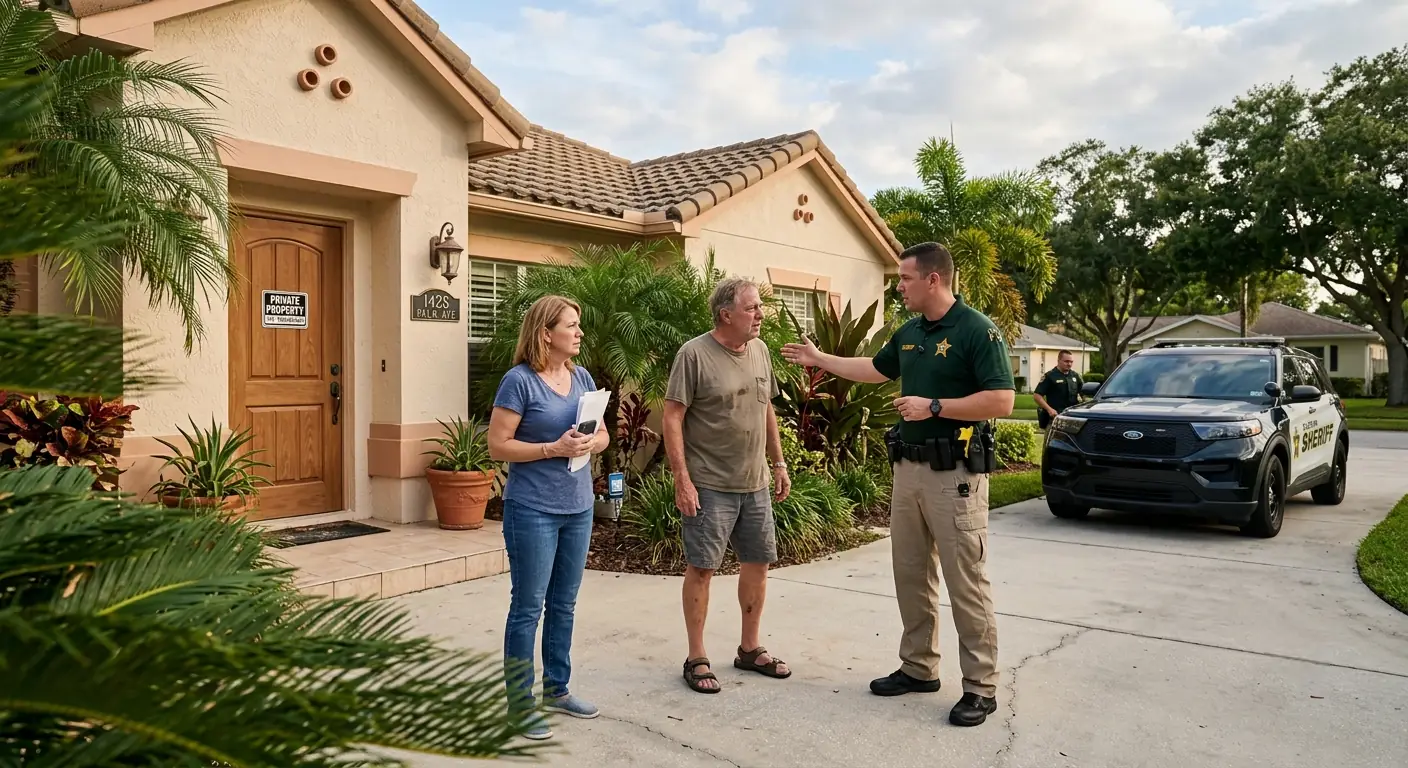
She drove out to her mother’s house in Middleburg to meet the lawn man and there was a car in the driveway she did not recognise.
Someone was living in it. Had been for a few weeks, they said. They had a lease, they said, from a man they found online who had shown them round and taken a deposit in cash.
The house had been empty since the funeral in March, and her first thought, standing in the road, was that this was going to take a year and cost her everything.
I’m Kady. I help Florida homeowners through foreclosure, hardship, inherited property, illness, divorce, and the whole category of things that happen to a house while nobody is looking at it. I am a Realtor with Momentum Realty and I buy houses.
I deal with a lot of empty houses. Inherited ones waiting on probate. Houses whose owner moved out during a default. Rentals between tenants. Snowbird properties shut up for eight months a year. And empty houses in Florida attract exactly this.
For years the advice was grim and basically correct: you had to go through a court process that took months, during which a stranger lived in your house for free and you paid the taxes and the insurance on it. That changed in 2024 and the change is a genuinely good one.
But it comes with a trap, and the trap has real teeth. Use this process against somebody who turns out to have been a tenant, and you can be sued for actual damages, three times the fair market rent, court costs and their attorney fees. So this article is as much about who this does not apply to as about how it works.
HB 621, effective 1 July 2024, created an optional process letting a property owner or their authorised agent file a verified complaint with the sheriff of the county where the property sits. You attest under penalty of perjury to a specific list of facts, including that the person is not a current or former tenant under an owner authorised rental agreement, is not an immediate family member, that there is no pending litigation between you, and that you have already directed them to leave. If the sheriff verifies you are the record owner and you appear entitled to relief, the sheriff must without delay serve a notice to immediately vacate and put you back in possession. The fee is the same as serving a writ of possession, currently $90, plus a reasonable hourly rate if you want a deputy to stand by while you change the locks. A person wrongfully removed can be restored to possession and recover actual damages, three times the fair market rent, costs and attorney fees. The same law created three new crimes, including a first degree felony for fraudulently listing or leasing a property you have no right to.
- This is for unauthorized occupants, not tenants. Get that wrong and it costs you treble rent plus their legal fees.
- You must have already told them to leave before you file. That is one of the sworn facts.
- You need proof you are the record owner. On an inherited house that may mean probate first.
- It is $90 plus an hourly rate if you want a deputy standing by.
- A lease from a scammer is not a tenancy with you, but speak to an attorney before relying on that.
- Prevention is cheaper than any of this. An empty Florida house is the whole problem.
01What HB 621 Changed
Before July 2024, the practical answer in Florida to “there is a stranger in my house” was a lawsuit. You filed, they answered or did not, it went on the docket, and somewhere down the line you got a writ. Meanwhile they lived there, you paid for everything, and the house got worse.
HB 621 created an alternative. It passed the Senate 39 to 0 and the House 108 to 0, which tells you something about how uncontroversial the problem had become, and it took effect on 1 July 2024.
The core of it is this. The owner of residential property, or their authorised agent, may submit a verified complaint to the sheriff of the county where the property is located. The complaint is sworn under penalty of perjury and sets out facts establishing that the people in the house have no right to be there. If the sheriff can verify that you are the record owner or their authorised agent and that you appear entitled to immediate relief, the sheriff must serve a notice to immediately vacate and put you back in possession.
No lawsuit. No hearing. No months.
Three things to be clear about before we go further.
It is optional. It does not replace the ordinary eviction or ejectment routes, it sits alongside them. If your situation does not fit cleanly, the old routes still exist and may be the right ones.
It is narrow on purpose. The eight sworn facts are the guardrails, and they are what stop this becoming a tool for throwing tenants out without process.
The liability runs to you. The sheriff is immune from liability for loss or damage to the occupant’s property. You are immune too, but only if the removal was lawful. If it was wrongful, the protection falls away.
02The Eight Things You Swear To
This is the heart of it. Everything in the list below has to be true, and you are signing under penalty of perjury that it is. Read it as a checklist and be honest with yourself at every line, because a convenient answer here is the most expensive thing on this page.
You are the owner, or their authorised agent
You will need a valid government issued ID, or, if you are acting as an agent, documents showing your authority to act. On an inherited property this is where people stall, because title may still be in the name of the person who died.
The property includes a residential dwelling
This process is about dwellings. Vacant land, commercial buildings and other property are not what it was written for.
The person or people unlawfully entered and are still there
Entered without authority, and remaining or residing. Not someone you let in who then stayed too long under some arrangement.
The property was not open to the public when they entered
Which matters for properties that were being shown, or that are open in some way.
You have already directed them to leave
You cannot go straight to the sheriff. You have to have told them to go first. Do it in a way you can evidence, and keep whatever proof you have.
They are not a current or former tenant under a rental agreement you authorised
This is the big one and the next section is entirely about it.
They are not an immediate family member of yours
Family disputes over a house are not what this was built for, and attempting to use it that way is a bad idea for several reasons at once.
There is no pending litigation between you and any known occupant
If you are already in court with this person over the property, this is not your route.
You also have to acknowledge, in signing it, that a false statement or wrongful use of the procedure can get you sued, and you accept liability for actual damages, statutory damages, penalties, costs and reasonable attorney fees.
That acknowledgement is not boilerplate. It is the whole design of the statute. The legislature made this fast by making you personally responsible for the accuracy of what you swear to.
03What The Sheriff Does
Once the complaint is in, the sheriff has specific duties.
Verify you. That you are the record owner or their authorised agent, and that you appear entitled to immediate relief.
Serve the notice without delay. A notice to immediately vacate is served on each unlawful occupant. Service may be by hand delivery or by posting on the front door or entrance, so a person who will not answer the door cannot stall it.
Put you in possession. That is the point of the whole exercise.
Try to identify everybody. The sheriff attempts to verify the identities of all occupants and records that on the return of service, which matters a great deal if there is damage to the property or anything else to pursue afterwards.
Arrest where there is cause. Any person found in the dwelling may be arrested for trespass, for outstanding warrants, or for other applicable legal cause.
On that standby. If you ask, the sheriff may remain to keep the peace while you change the locks and remove the occupants’ property, charging a reasonable hourly rate. Take that option. It costs very little relative to everything else, and the alternative is you, alone, at a house, with people who have just been told to get out. Nothing good happens in that version.
04Who This Does Not Apply To
I want to spend real time here, because this is the section that protects you.
This process is for people who unlawfully entered your property. It is not a shortcut around the eviction laws, and Florida’s eviction laws exist for good reasons.
Do not use this process if any of the following is true.
They are or were a tenant under a rental agreement you authorised. Even an expired lease. Even a month to month that has gone bad. Even somebody who has not paid in six months. A non paying tenant is a tenant, and removing a tenant goes through the eviction process, full stop.
You took money from them. Rent, a deposit, anything. If money changed hands between you and the occupant for the use of the property, you may well have created a tenancy whether you intended to or not. Stop and ring an attorney.
They are immediate family. The sibling who moved into Dad’s house after the funeral, the adult child who will not leave, the estranged spouse. These are painful, real problems and this is not the tool for them. They go through ejectment or a family or probate proceeding.
You let them stay. The friend who was crashing for a fortnight nine months ago. The ex partner. The person who was house sitting. Permission that has gone stale is not the same as unlawful entry, and a court may see a licence or a tenancy at sufferance where you see a freeloader.
There is already litigation between you. One of the sworn facts, and a hard stop.
You are not sure. If you are reading this list and arguing with it in your head, that is your answer. Spend an hour with a Florida real estate attorney first. An hour of advice is enormously cheaper than treble rent plus their fees.
A person who is wrongfully removed under this process can be restored to possession and can recover actual damages, statutory damages equal to three times the fair market rent of the dwelling, court costs and reasonable attorney fees. On a house renting at $2,200 a month, treble statutory damages alone are a serious number before anybody’s legal bill is added. And you will have signed a document under penalty of perjury saying the facts were otherwise. This is not a provision anybody should be casual about.
05Three New Crimes
HB 621 also created criminal offences, and these are worth knowing because they change what you can realistically expect law enforcement to do.
Second degree felony
Damaging a dwelling you are unlawfully occupying
Unlawfully detaining, occupying or trespassing on a residential dwelling and intentionally causing damage over $1,000. A second degree felony, punishable by up to 15 years and a fine of up to $10,000. This is the one that matters when you walk into a trashed house.
under s. 806.13
First degree misdemeanour
Presenting a false lease or deed
Knowingly and willfully presenting a false document purporting to be a valid lease, deed or other document conveying property rights, with intent to remain on or detain the property. A first degree misdemeanour, up to a year and a $1,000 fine.
under s. 817.03
First degree felony
Fraudulently selling or leasing a property
Listing or advertising a residence for sale knowing the purported seller has no legal title or authority to sell, or leasing a property knowing the lessor has no ownership or leasehold interest. A first degree felony, up to 30 years and a fine of up to $10,000.
under s. 817.0311
Why it matters to you
It changes the conversation
Before this, an officer at your door could reasonably say it looked like a civil matter. Now there are specific offences on the books covering exactly what happened to you. That does not guarantee an arrest, but it means the report you file is about a crime rather than a dispute.
file the report either way
That third one is worth pausing on. A first degree felony is extremely serious, and it is aimed squarely at the people running the scam rather than at the families who fall for it. Which brings us to the situation I see most often.
06Why Empty Houses Attract This
Nobody picks a house at random. They pick one that looks unwatched, and in my experience there are five reliable ways a Florida house comes to look unwatched.
Probate. The biggest one by a distance. Somebody dies, the house sits for months while the family sorts out the legal side from three different states, and the lawn gets long. If probate is what is holding you up, the summer’s change to the small estate threshold may have made that faster and cheaper than you think, and I have written about it in Florida’s small estate limit just doubled to $150,000.
Default. Owners who move out during a foreclosure, often because somebody told them they had to, which is usually wrong. You own it until the sale, and walking away early just hands the property to whoever finds it first.
Between tenants. A gap of six weeks is enough.
Snowbirds. Eight months of visible absence every year, on a predictable schedule.
Listings. Vacant, staged, lockbox on the door, photographs of every room published online. That last one is how the scammers get the interior shots for their fake rental ads.
Prevention is unglamorous and it works. Someone physically looking at the property on a schedule. Mail and packages collected rather than piling up. The lawn maintained, because long grass is the single clearest signal. Lights on timers. Good locks and, if it is sitting for months, a camera at the door. And tell your insurer the property is vacant, because vacancy changes coverage and a lot of people discover that only after a claim is denied.
07If They Have A Lease From A Scammer
This is the version I see most, and it is genuinely sad on both sides.
Somebody found your empty house, took photographs or lifted them off an old listing, advertised it as a rental, met a family at the door, showed them round, took first month and a deposit in cash, and vanished. The family moved in believing they had rented a home. They have a lease, signed, with a name on it. They may also have a receipt.
Two things are true at the same time and you have to hold both.
That is not a tenancy with you. You did not authorise it. A lease signed by somebody with no ownership or leasehold interest did not create a landlord and tenant relationship between you and the occupants. That is precisely what the new first degree felony describes.
And you should still ring an attorney before filing. Because a document exists, because the family will produce it, and because the question of whether the sworn facts are accurate now has an argument attached to it. A short consultation here is money extremely well spent.
Also do these two things regardless. File a police report about the fraudulent lease, naming the person who took the money if you can identify them, because the offences above exist now and because the victims will need that report. And be decent to the family. They were robbed. They are about to be removed from a home they paid for, and they have lost the money as well. None of that is your fault and none of it is theirs either. Handling it with some humanity costs you nothing and it is the right thing to do.
What people believe
Squatters have rights in Florida and after 30 days I will never get them out.
What is true
Since 1 July 2024 a sworn complaint to the sheriff can get an unauthorized occupant removed without a lawsuit, often in days.
What people believe
It is my house, so I can change the locks and put their things on the kerb myself.
What is true
Self help is how owners end up liable. Use the process, and pay the hourly rate for a deputy to stand by while you change the locks.
What people believe
My tenant has not paid in five months, so they are basically a squatter now.
What is true
A non paying tenant is still a tenant. Using this process on them exposes you to treble rent, costs and their attorney fees.
08After They Are Out
Getting possession back is the beginning of the next problem, so plan for it.
Secure it the same day. New locks on every exterior door, every window checked, the garage and any side gate. People come back. Do not leave a four hour gap between the removal and the locksmith.
Photograph everything before you touch it. Every room, every piece of damage, timestamped, before any cleaning starts. If the damage is over $1,000 there is now a second degree felony that describes it, and your photographs are what makes that report mean anything.
File the police report. Even if you doubt anyone will be caught. It documents the loss, it supports an insurance claim, and it is the only way a pattern of this gets noticed in your area.
Call your insurer, carefully. Report the damage, and be aware that vacancy provisions may affect coverage. Know what your policy says before you make the call rather than after.
Check the public records. This is the one people forget. Pull up the property on your county’s official records and make sure nothing has been recorded against it, no deed, no lease, no lien. The false documents offence exists because people do record things. If anything is there, that is an attorney’s problem immediately.
Then decide what the house is. A property that has sat empty, been occupied by strangers and taken some damage is a different asset from the one you thought you had. Sometimes the right answer is to repair it and list it. Sometimes, particularly with an inherited house and heirs in three states who cannot keep driving out there, the right answer is to sell it as is and be done. I buy houses in exactly that condition and I have written about how that works in selling a house as is for cash in Florida. If listing it is the better move, I will tell you that too.
The house in Middleburg had a family in it with a lease from a man who does not exist.
She saw an attorney, filed the complaint, and they were out in under a week. The sheriff stood by while the locksmith worked. There was damage, but not the kind you cannot come back from.
What stayed with me was that she gave that family two weeks to find somewhere and helped them get a copy of the police report for the money they lost. She did not have to do any of that.
She sold the house to me in August because she lives in Georgia and could not keep driving down. I would have told her to list it if the numbers had said so. They did not.
If the house is still in a dead person’s name
This is the most common complication I run into with this process and it stops people at the first sworn fact. The sheriff has to verify that you are the record owner or their authorised agent, and if title is still in your late parent’s name, you are neither on paper. Which means the probate question you have been putting off is suddenly urgent. The good news is that it may be far quicker and cheaper than you have assumed, because the summary administration ceiling doubled to $150,000 on 1 July 2026 and protected homestead is generally excluded from that calculation. Take this to a Florida probate attorney and tell them there are people in the house, because that changes how they prioritise it.
Tell me what the situation is and I will tell you honestly whether this is the route, whether you need an attorney first, and what I would do about the house afterwards.
Questions People Ask Me
How do I remove a squatter in Florida?
Since 1 July 2024 there is a process that avoids a lawsuit. The property owner or their authorised agent submits a verified complaint, sworn under penalty of perjury, to the sheriff of the county where the property is located. If the sheriff can verify you are the record owner or authorised agent and you appear entitled to immediate relief, the sheriff must without delay serve a notice to immediately vacate and put you back in possession. The fee is the same as serving a writ of possession, currently $90, plus a reasonable hourly rate if you want a deputy to stand by.
What is HB 621?
It is the Florida property rights bill that took effect on 1 July 2024, creating the sheriff removal process for unauthorized occupants of residential dwellings. It also gave wrongfully removed persons a cause of action against the owner, and created three new criminal offences covering damage caused while unlawfully occupying a dwelling, presenting false documents to remain on a property, and fraudulently listing or leasing property. It passed the Senate 39 to 0 and the House 108 to 0.
What exactly do I have to swear to?
That you are the owner or authorised agent, that the property includes a residential dwelling, that the person unlawfully entered and remains, that the property was not open to the public when they entered, that you have already directed them to leave, that they are not a current or former tenant under a rental agreement you authorised, that they are not your immediate family member, and that there is no pending litigation between you and any known occupant. You also acknowledge liability for damages, costs and attorney fees if you use the process wrongfully.
How fast does it work?
Much faster than the court route it replaces. The statute requires the sheriff to act without delay once the complaint checks out, and service can be by hand delivery or by posting on the front door, so an occupant who will not answer cannot stall it. In practice I have seen it resolve within a week. Compare that to an ejectment action, which runs on a court docket and can take months while the occupant lives there for free.
Can I use this on a tenant who has stopped paying rent?
No, and this is the most important warning on the page. A tenant under a rental agreement you authorised is not an unauthorized occupant, even if the lease has expired, even if they have not paid in months. Removing a tenant goes through Florida’s eviction process. Using the sheriff process against a tenant exposes you to restoration of their possession plus actual damages, statutory damages of three times the fair market rent, court costs and their reasonable attorney fees.
What if the person is my brother or my adult child?
Then this process is not available to you, because one of the sworn facts is that the occupant is not an immediate family member of the owner. Family disputes over occupancy of a house go through ejectment, or through a probate or family proceeding depending on the situation. These are genuinely difficult cases, both legally and personally, and they need a Florida attorney rather than a self help route.
They have a lease. Does that stop me?
Not necessarily, but get advice before you file. If the lease was signed by somebody with no ownership or leasehold interest in the property, it did not create a tenancy between you and the occupants, and the person who did it may have committed a first degree felony under the new law. But a document exists, the occupants will produce it, and whether your sworn facts hold up now has an argument attached. A short consultation with a Florida real estate attorney before filing is money very well spent.
Can I just change the locks myself?
Do not. Self help removal is how property owners end up on the wrong side of this, exposed to claims for damages and sometimes to criminal exposure of their own. The entire value of the new process is that it is fast and lawful. Use it, and when you do, pay the reasonable hourly rate for a deputy to remain and keep the peace while you change the locks and remove property. It costs very little relative to everything else at stake.
What does it cost?
For serving the notice, the sheriff may charge the same fee as for serving a writ of possession, currently $90. If you ask the sheriff to stand by to keep the peace while you change the locks and remove the occupants’ property, a reasonable hourly rate applies on top. Against months of unauthorized occupancy while you pay the taxes, insurance and utilities, and against the cost of an ejectment action, this is the least expensive part of the entire problem.
The house is still in my late mother’s name. Can I still do this?
Not until you can show you are the record owner or their authorised agent, which is the first thing the sheriff verifies. That makes the probate you have been postponing suddenly urgent. The good news is that it may be quicker and cheaper than you expect: Florida’s summary administration ceiling doubled to $150,000 on 1 July 2026, protected homestead is generally excluded from that calculation, and a death more than two years ago qualifies regardless of value. Tell the probate attorney there are people living in the house.
What if they damaged the property?
Photograph everything before you touch or clean anything, timestamped, room by room. Under the 2024 law, unlawfully detaining, occupying or trespassing on a residential dwelling and intentionally causing damage over $1,000 is a second degree felony, punishable by up to 15 years and a fine of up to $10,000. File a police report. Then call your insurer, knowing in advance what your policy says about vacancy, because vacancy provisions can affect coverage.
Should I check the public records afterwards?
Yes, and almost nobody does. Pull the property up in your county’s official records and confirm that nothing has been recorded against it: no deed, no lease, no lien, nothing. The new offence for knowingly presenting a false document purporting to convey property rights exists because people genuinely attempt this. If you find anything recorded that you did not put there, that is a matter for a Florida real estate attorney straight away, not something to deal with later.
How do I stop this happening in the first place?
Make the house look watched, because nobody picks a property at random. Have somebody physically check it on a schedule. Keep the lawn cut, because long grass is the clearest signal there is. Collect the mail and packages. Lights on timers, good locks, and a doorbell camera if it is sitting for months. Tell your insurer the property is vacant, since vacancy changes coverage and people usually discover that after a claim rather than before.
Does this apply to vacant land or a commercial building?
No. The sworn facts include that the property includes a residential dwelling, so this process is built for homes. For vacant land, commercial property or other situations outside the statute, the older routes still exist, including ejectment and trespass remedies. Which one fits is a question for a Florida attorney, and the fact that this particular fast route does not apply does not mean you have no remedy.
They are out. Should I keep the house or sell it?
That depends on numbers rather than feelings, and I will give you an honest read either way. Consider what the damage costs to put right, whether anyone can realistically supervise repairs if the heirs live out of state, what the holding costs are each month in taxes and insurance, and how a vacancy clause on your policy affects you in the meantime. Sometimes repairing and listing nets considerably more. Sometimes selling as is, today, to someone who takes the condition and the hassle, is the better result for everybody.
Keep reading
A gentle note: I am a Florida Realtor with Momentum Realty and a home buyer, not an attorney or a law enforcement officer, and this is general information rather than advice about your property or your occupants. Whether a particular person is an unauthorized occupant or a tenant is a legal question with serious consequences attached to getting it wrong, including restoration of possession, actual damages, statutory damages of three times the fair market rent, court costs and attorney fees. Statutory references here reflect publicly available information as of October 2026 regarding CS/CS/HB 621, effective 1 July 2024, and the offences it created under sections 806.13, 817.03 and 817.0311, Florida Statutes. Please speak with a licensed Florida real estate attorney before using this process, and contact your county sheriff’s office for their current forms, fees and procedure.
Written by Kady Andreoli, founder of Helping Hand Home Solutions FL and a Realtor with Momentum Realty. Helping Florida homeowners explore every available option, from stopping foreclosure to selling on their own terms. Guidance without judgment, and people before profit. 904-400-2131 · kady@helpinghandhomesfl.com