

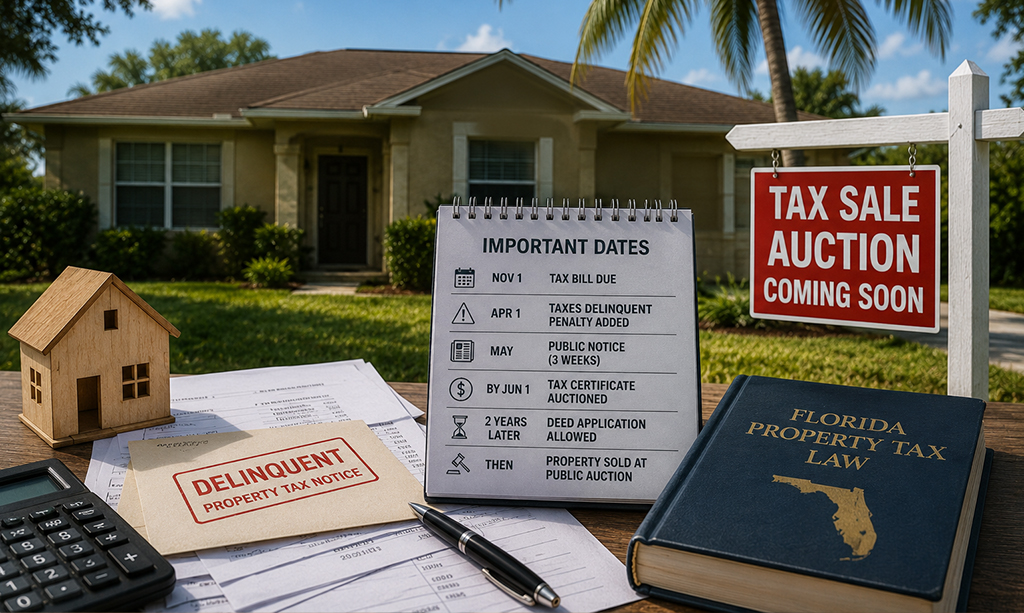
Almost everything written about losing a home assumes there's a bank involved. A mortgage, a servicer, a loan you fell behind on. But some of the hardest situations I see have no lender in them at all. The house is paid for. It's been in the family thirty years. And it's about to be sold at auction over a tax bill.
That's the good news, and I put it first on purpose. This process is slow and it's public and there are several places to step in front of it.
The bad news is that nobody explains it, so people find out when a stranger knocks on the door.
I'm Kady. I help Florida homeowners through hardship, inherited houses, foreclosure, and the situations nobody warns you about. This one comes up most with two groups: older folks on fixed incomes whose tax bill outgrew their budget, and families who inherited a house and didn't realize taxes were still stacking up on an empty place. Almost nothing on this page earns me a dollar. No pressure. Just someone in your corner.
Florida property taxes are due November 1 and go delinquent on April 1. The county then sells a tax certificate on or before June 1, which is a lien, not ownership. Two years after that April 1 date, the certificate holder can apply for a tax deed, which sends your property to a public auction run by the clerk of court. You can redeem and stop it any time before it's sold. If the home is your homestead, the opening bid must include an extra amount equal to one half of the assessed value, and that money is treated as surplus rather than going to the buyer. And if a sale already happened, there may be surplus money waiting that belongs to you.
- A paid off house is not a safe house. Property taxes are a first lien on your property, ahead of almost everything.
- You have about two years, and you can redeem right up until the auction.
- A certificate holder is not your landlord. They can't enter, and they can't demand payment for two years.
- Homestead adds real protection. Half the assessed value gets built into the opening bid.
- Surplus money is real and it goes unclaimed constantly. Call the clerk.
01How Someone Loses a Paid Off House
Property taxes in Florida are a first lien on your property. Ahead of a mortgage. Ahead of most everything. That's how a house with nothing owed on it can still be taken.
It almost never happens because somebody refused to pay. It happens like this.
A widow's homestead exemption situation changes and the bill climbs. Insurance goes up the same year. She pays what she can and lets the tax bill slide one season, meaning to catch it up.
Or a parent dies and three siblings inherit a house nobody lives in. The homestead cap resets, the bill roughly doubles, and everyone assumes somebody else is handling it. Nobody is.
Or the tax bill went to an address the owner moved away from years ago. Under Florida law, not receiving a bill doesn't excuse the debt. Every owner is held to know taxes are due.
That's the whole story, most of the time. Not negligence. A gap, and then a process that runs quietly in the background for two years while nobody realizes the clock is going.
02The Timeline You Actually Have
Short answer: taxes go delinquent April 1, a certificate sells by June 1, and a tax deed application can't be filed until two years after that April 1.
Nov 1
Tax bill due
April 1
Delinquent, penalty added
May
Advertised publicly, three weeks
By June 1
Tax certificate auctioned
2 years later
Deed application allowed
Then
Clerk sells at public auction
Two things about that strip are worth sitting with.
First, the whole thing is public from May of year one. Your name and parcel get advertised once a week for three weeks. That's how investors find you, and it's also how you can check on a relative's property if you're worried about them.
Second, the two year mark is when the certificate holder may apply. It isn't automatic and it isn't the end. After the application, the clerk has to notice everyone with an interest and schedule a sale, which takes more months. And through all of it you can redeem.
03What a Tax Certificate Is, and Isn't
This is where the fear comes from, and most of it is misplaced.
😰 What people think
Somebody bought my house at the courthouse for a few thousand dollars and now they own it.
💚 What's true
They bought a lien. A tax certificate does not convey title and does not make anyone your co owner. It's an investment in your debt, not in your house.
😰 What people think
They can come look at the property, or show up and pressure me to pay.
💚 What's true
Buying a certificate gives no right to enter your property. Florida law also bars the holder from contacting you to encourage or demand payment until two years after April 1 of the year it was issued, and a holder who does can be barred from bidding at future sales.
😰 What people think
It's hopeless now. The debt is with a stranger and I can't do anything about it.
💚 What's true
You redeem through your county tax collector, not through the investor. You pay the taxes, interest, and costs, the certificate is satisfied, and the matter is closed.
The interest is the part that stings. Certificates are awarded to whoever bids the lowest interest rate, with a ceiling of 18 percent a year, so the longer it sits the more it takes to clear. That's an argument for moving early, not for panicking.
Not sure where your property stands? Send me the address and I'll help you find out what's actually owed and where in this process it sits. That's a public records question and it costs nothing. I'm Kady: call or text 904-400-2131, or email kady@helpinghandhomesfl.com.
04The Homestead Protection Nobody Mentions
Short answer: if the property is assessed as homestead, the opening bid at auction must be raised by one half of the assessed value.
Of the assessed value gets added to the minimum bid on homestead property. Florida law requires it, and the statute then treats that amount as surplus rather than as money the buyer keeps.
Think about what that does. On a home assessed at $200,000, an extra $100,000 has to be on the table before anybody can take it. It makes a cheap grab much harder, and it means that if a sale does happen, there's a meaningful pot of money that is supposed to flow back rather than disappear into the purchase.
This is one of the better consumer protections in Florida law and almost nobody knows it exists. It's also a strong argument for making sure your homestead exemption is actually on file, which is worth a call to your county property appraiser regardless of your tax situation.
05If It Already Sold, You May Be Owed Money
Short answer: when a property sells for more than the statutory opening bid, the extra is surplus, and it does not belong to the buyer.
The clerk of court holds it. Lienholders and other interested parties have 120 days from the notice to file a claim, and anyone other than the property owner who misses that window is barred. If no claims come in during that period, Florida law creates a conclusive presumption that the legal titleholder of record is the one entitled to the money.
Which means: if you or a family member lost a property this way, there may be money sitting with the clerk right now with your name attached to it.
First, move on it. Clerks eventually process unclaimed money into the state's unclaimed property system, and getting it back from there is slower and more annoying. Second, and more important: the moment a tax deed sale happens it becomes public, and people appear offering to recover your surplus for a percentage. You can file a claim yourself, directly with the clerk, for free. If a claim is genuinely complicated, an attorney is a better answer than a finder taking a cut of your own money.
06How to Stop It Before Any of That
In order of how easy they are. Start at the top.
Call the tax collector
Free, and the fastest fix
Ask what's owed, what it takes to redeem, and whether you can get on the installment plan for next year. These offices deal with this constantly and they'd rather collect than send anything to auction. There's a signup window for the installment plan, so ask about the deadline while you're on the phone.
Do this firstAsk about a tax deferral
For those who qualify
Florida law provides for deferring property taxes in certain circumstances, with the deferred amount becoming a lien that comes due later, including if ownership or use changes. It isn't right for everyone and it isn't forgiveness, but for an older owner on a fixed income it can be the difference between staying and not.
Ask, then read carefullyCheck your exemptions
Free money people leave behind
Call the property appraiser and confirm you're getting every exemption you're entitled to, including homestead and any additional exemption for seniors. If you inherited the home and moved in, you have to apply for your own, and there's a filing deadline in the spring.
Worth one phone callSell before the auction
When the bill has outrun the budget
If the taxes keep coming and the money isn't going to be there next year either, selling on your own terms beats losing it at auction by a wide margin. The taxes come out of the proceeds at closing and the rest is yours. On the market if the house shows well, as is if it doesn't.
Keeps your equityIf the house is one you inherited and the tax bill jumped after the owner died, that's a specific and very common trap. I explained why it happens and what to do about it in the inherited property guide on this site, and in some people see a distressed property, I see possibilities if the condition is part of the problem.
"The people this happens to are almost never careless. They're widows whose bill outgrew their pension. They're families who inherited a house in a hard year. Life doesn't always go according to plan, and a tax bill doesn't care what kind of year you've had. There's no judgment here, only help. You don't have to have all the answers when you reach out. You just need somebody who can help you understand your options and walk through them with you."
Find out where you really stand. It's public record.
Send me the address and I'll help you work out what's owed, where in the process it sits, and what your realistic options are. If a call to the tax collector fixes it, that's the answer and I'll say so. If selling before the auction protects your equity, I'll give you a fair, no obligation number.
Get My Cash Offer Just Talk to Kady07Questions People Ask Me
Can you really lose a house in Florida over unpaid property taxes?
Yes, even with no mortgage on it. Taxes go delinquent April 1, the county sells a tax certificate on or before June 1, and two years after that April 1 date the certificate holder can apply for a tax deed, which sends the property to a public auction. None of the protections that apply to mortgage foreclosure apply here.
How long do I have before my property can be sold?
A tax deed application generally can't be filed until two years after April 1 of the year the taxes became delinquent, and the auction comes some months after that. You can redeem and stop the sale at any point up until the property is actually sold at public auction.
Does someone owning a tax certificate mean they own my house?
No. A certificate is a lien, not a deed. It doesn't convey title, it gives no right to enter your property, and Florida law bars the holder from contacting you to demand payment until two years after April 1 of the year it was issued.
Is there any protection if it's my homestead?
Yes, and it's a real one. If the property is assessed as homestead on the latest tax roll, the opening bid at the tax deed auction has to be increased by an amount equal to one half of the assessed value. The statute then treats that amount as surplus, so it gets distributed rather than pocketed by the buyer.
If my house already sold, am I owed anything?
Possibly, and people miss this constantly. If it sold for more than the statutory opening bid, the excess is surplus held by the clerk of court. Lienholders have 120 days from the notice to claim, and if no claims are filed in that window Florida law presumes the legal titleholder of record is entitled to it. Call the clerk in that county and ask directly. You don't need to pay anyone a percentage to do that.
What if I just can't afford the bill?
Call the county tax collector before April 1 and ask about the installment plan and whether you qualify for a deferral. Then call the property appraiser and confirm you're receiving every exemption you're entitled to. Both conversations are free, and both offices would rather work with you than watch a property go to auction.
A gentle note: I'm a Florida home buyer, not an attorney, accountant, or tax professional, and this article is general information rather than advice for your situation. Chapter 197 of the Florida Statutes is detailed, county practices and deadlines vary, and the rules change. Please confirm anything that matters directly with your county tax collector, property appraiser, or clerk of court, and talk with a licensed Florida attorney about your specific circumstances before making a decision about your property.
- Florida Statutes Chapter 197: tax collections, sales, and liens
- Section 197.432: sale of tax certificates, and limits on contacting property owners
- Sections 197.502 and 197.542: tax deed applications and the homestead opening bid
- Section 197.582: disbursement of sale proceeds and surplus funds
- Your county tax collector: redemption amounts, installment plans, and deferrals
- Your county property appraiser and clerk of court: exemptions, and surplus fund claims