

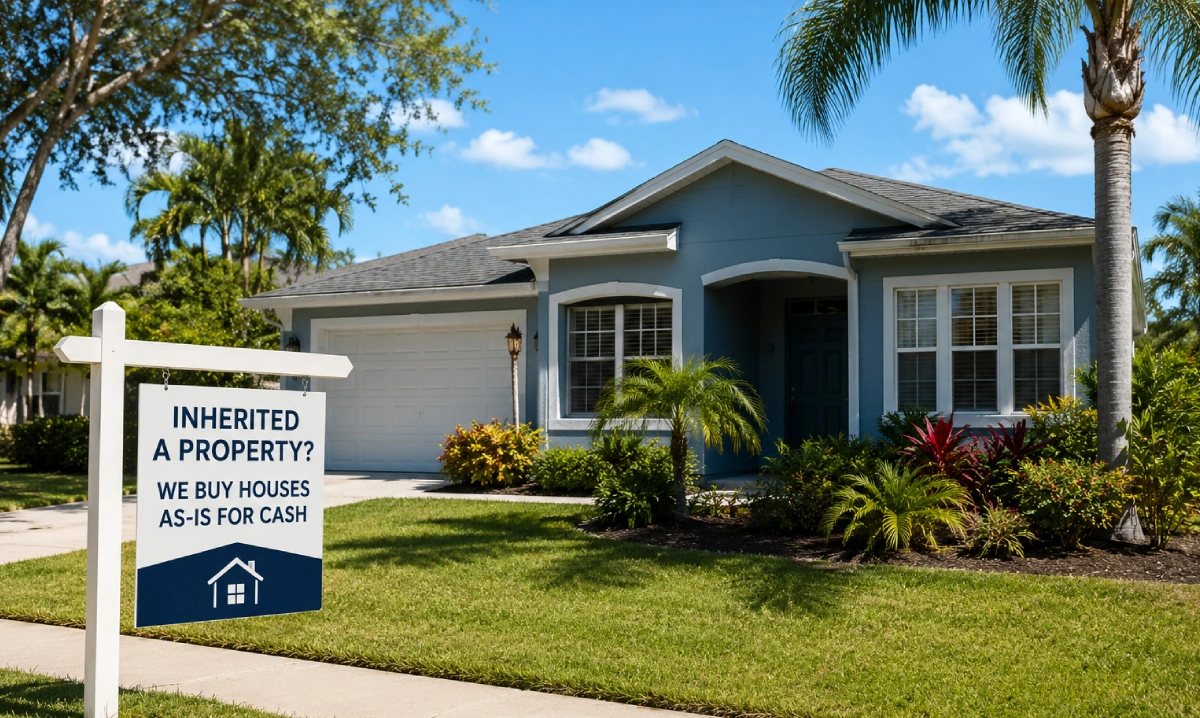
First, take a breath. If you're reading this, there's a good chance you recently lost someone you love - and now, on top of the grief, there's a house. A house that needs decisions you never asked to make. That's a heavy thing to carry, and you don't have to figure it all out today. Let's just walk through it together, one step at a time.
I'm Kady. I help Florida families who've ended up with a property they're not sure what to do with. Some want to keep it, some need to sell, and a lot of people honestly just want someone to explain what's going on without a sales pitch. So that's what this is. No pressure - I promise. Just the plain-English version of what happens when you inherit a house in Florida, and the options you actually have.
When you inherit a house in Florida, it usually has to pass through probate (the court process that puts the home legally in your name) before it can be sold - unless it was in a trust or had a survivorship/transfer-on-death deed. The good news: thanks to the step-up in basis rule, most families owe little or no capital gains tax if they sell soon after, and Florida has no estate or inheritance tax. From there you have four real options - keep it, rent it, list it, or sell it as-is. If the house is far away, full of belongings, or costing you money every month, selling as-is for cash is often the least stressful path. I'm a local cash home buyer in Jacksonville and across Florida, and I'm glad to help you weigh it - even if you decide not to sell to me.
- You don't have to rush. Grief and big decisions don't mix well - most choices here can wait a few weeks.
- Most homes must clear probate first before you can sell - but you can start the process and sell during it.
- You probably won't owe much tax. The step-up in basis usually wipes out capital gains, and Florida has no inheritance tax.
- You don't have to fix it or empty it. An as-is sale means you can leave the repairs, the clutter, all of it.
- You have four options - keep, rent, list, or sell as-is. There's no single "right" answer, only what's right for you.
01It's Okay to Feel Overwhelmed
Most people who call me open with some version of "I'm sorry, I don't even really know what I'm asking." Please don't apologize. Inheriting a house is genuinely confusing, and it almost always shows up at the worst possible time - while you're planning a funeral, sorting through a lifetime of belongings, and trying to hold the rest of your life together.
And it's not just the paperwork. There's the guilt of thinking about money right after a loss. The sibling who wants to keep it and the one who needs to sell. The house three hours away that you can't keep driving to. The insurance and the property taxes quietly draining your bank account every single month. If any of that sounds familiar, you're not doing anything wrong - you're just carrying a lot at once.
02Do You Have to Go Through Probate?
Here's the thing that trips most people up: even if the will clearly says "I leave the house to my daughter," that daughter usually can't just sell it the next day. In Florida, when a home is titled only in the name of the person who passed, it has to go through probate - the court process that officially moves ownership to the living. Until that happens, no one has the legal authority to sign the deed.
There are a few happy exceptions where you can skip probate entirely. You generally don't need it if the house was:
- Held in a living trust,
- Set up with a Lady Bird deed or transfer-on-death deed,
- Or owned jointly with right of survivorship (for example, with a spouse who's still living).
If none of those apply, you'll go through one of Florida's two probate tracks - and which one matters a lot for how long this takes:
| Track | When it applies | How long |
|---|---|---|
| Summary administration | Smaller estates, or when the person passed more than 2 years ago | A few weeks to a couple of months |
| Formal administration | Larger or more complex estates | About 6–12 months |
Florida just doubled the cutoff for the faster "summary administration" track - from $75,000 to $150,000 in non-exempt assets. And here's the part families miss: the homestead (the house itself) usually doesn't count toward that limit. So a family inheriting a $400,000 home plus, say, $100,000 in accounts can often still use the quicker, cheaper process. If someone told you a while ago that you'd need the long formal route, it may be worth asking a probate attorney again under the new rules.
I'm not an attorney, and I'd never pretend to be - for your exact situation, a Florida probate attorney is who you want (many handle uncontested cases for a flat fee). But knowing which track you're likely on helps you understand the timeline before you make any decisions.
03The Probate-to-Sale Path, Step by Step
When you can see the whole path laid out, it feels a lot less scary. Here's roughly how it goes from "I inherited a house" to "it's sold and settled":
Open probate
File with the county court
Get authority
Court issues "Letters"
Secure & value
Insure it, get an appraisal
Choose a path
Keep, rent, list, or sell
Close & settle
Title company handles it
One important Florida detail on that "secure it" step: our humidity is no joke. An empty house here can grow mold within weeks, and many insurance policies add a "vacancy" clause after 30–60 days that can leave a sitting home under-covered. So if the house is going to be empty for a while, tell the insurer, keep some air moving, and don't let it sit ignored. It's one of the quiet ways an inherited house starts costing you money.
Not sure which step you're even on? That's the most common call I get. Tell me a little about the house and I'll help you figure out where you stand - no cost, no pressure. Call or text me, Kady, at 904-400-2131 or email kady@helpinghandhomesfl.com.
04What About Taxes? (Better News Than You Think)
This is the part that keeps people up at night, and honestly, it's usually where I get to give good news. Two things work in your favor in Florida:
Florida has no estate or inheritance tax
Our state constitution actually prohibits it. So you won't pay a state "death tax" on the house. And the federal estate tax? It only kicks in on estates worth more than $15 million per person - which means for almost every family I talk to, it simply doesn't apply.
The "step-up in basis" usually erases capital gains
This one's a gift, and a lot of people have never heard of it. When you inherit a house, the IRS "resets" its value for tax purposes to what it was worth on the day the person passed - not what they originally paid decades ago. That reset is called the step-up in basis.
Here's why it matters: say your mom bought her home for $60,000 in 1990, and it's worth $360,000 now. If she'd sold it while living, she might have owed tax on $300,000 of gain. But because you inherited it, your "starting point" becomes $360,000. Sell it soon after for around that price, and there's little or no capital gain to be taxed at all.
Get a dated appraisal (or a broker's price opinion) as of the date of death. It sets your official "starting value" on paper, so if the numbers ever come up later, you're covered. It's a small step that can save a real headache. And for the tax specifics of your situation, a quick chat with a CPA is money well spent.
05Your Four Real Options
Once the legal side is moving, it comes down to a very human question: what do you actually want to do with this house? There's no wrong answer here - only the one that fits your life, your family, and your finances. Here are the four paths, honestly laid out:
Keep it
Move in, or hold onto it
Wonderful if it's the family home and you can afford the taxes, insurance, and upkeep. Just go in clear-eyed about the ongoing monthly cost.
Best if it's sentimental & affordableRent it out
Turn it into income
Can be a nice long-term asset - but you're now a landlord, with repairs, tenants, and Florida's insurance costs. More work than most people expect.
Best if you want income & can manage itList it with an agent
Sell on the open market
Usually gets the highest price - but expect repairs, cleaning, showings, agent commissions, and often 60–90+ days. Hard if the house needs work or you live far away.
Best if it's in good shape & you can waitSell it as-is for cash
The low-stress path
Leave the repairs, leave the clutter, pick your closing date. Less than a full-price listing, but no fees, no fixing, no showings - often done in a week or two.
Best if it's far, dated, or draining youIf you're leaning toward keeping or listing and the house is in good shape, that may well be your best move - and I'll tell you so honestly, even though I'm a buyer. But if the property is out of town, hasn't been updated in decades, is full of a lifetime of belongings, or is costing you money every month you hold it, an as-is sale usually takes the most weight off your shoulders.
Want a real number, with zero obligation?
Tell me about the house and I'll get you a fair, no-pressure cash offer - and an honest opinion on whether selling even makes sense for you.
Get My Cash Offer Just Ask a Question06When Siblings Don't Agree
If you inherited the house with your brothers or sisters, you already know this can get tender fast. One of you wants to keep Mom's house exactly as it is. One of you lives out of state and just needs their share. One of you has been quietly paying the taxes and is running out of patience. All of those feelings are valid, and all of them are sitting on top of grief.
A few things that tend to help families get through it:
- Name the feelings before the money. Most fights aren't really about dollars - they're about memories, fairness, and feeling heard. Say that part out loud first.
- Get one neutral number everyone trusts. A fair market value (and a real cash offer) gives everyone the same starting point instead of guesses.
- Consider a clean sale and split. When keeping it isn't realistic for everyone, selling and dividing the proceeds is often the fairest, least resentful path - nobody's stuck being the landlord or the one left holding the bills.
- Let a third party handle the logistics. Sometimes it's easier when the clean-out, the paperwork, and the timeline aren't any one sibling's job to nag about.
07Selling As-Is: What It Really Means
"As-is" gets thrown around a lot, so let me tell you plainly what it means when you sell an inherited house to a local buyer like me - and what it saves you:
- You don't fix anything. Old roof, dated kitchen, that bathroom nobody's touched since 1985 - none of it matters. I buy it exactly as it stands.
- You don't clean it out. This is the big one for inherited homes. You can take what's meaningful to you and leave the rest. You don't have to sort through every drawer of a lifetime. A good buyer handles the clear-out.
- No agent fees or commissions. A traditional sale can cost 6% in commission plus closing costs. An as-is cash sale skips the commissions entirely.
- No showings, no strangers walking through. Especially comforting when it's a family home and you're still grieving.
- You choose the closing date. Need to wait for probate to finish, or for a sibling to fly in? We close when you're ready - sometimes in as little as a week or two once you're clear to sell.
The honest trade-off: an as-is cash offer is typically below what a fully renovated, listed home might fetch on a good day. What you're trading that difference for is speed, certainty, zero repair costs, and not having to lift a finger. For a lot of families - especially with an out-of-town or run-down house - that trade is more than worth it. For others, listing makes more sense. I'll always give you my honest read on which is which.
"I started Helping Hand because I kept meeting good people going through the worst weeks of their lives, being treated like a lead instead of a human being. That's not how I do things. If you call me about a house you inherited, I'm going to ask how you're doing first. I'll tell you the truth about your options - even the ones that don't involve me - because a clear head matters more than a quick deal. Whatever you decide, I want you walking away feeling like someone finally helped."
You can just talk it through with me. No form to fill out, no obligation. I'm Kady - reach me directly at 904-400-2131 or kady@helpinghandhomesfl.com. If you'd rather read first, grab my free, no-obligation cash offer whenever you're ready.
08Questions People Ask Me
Can I sell the house before probate is finished?
In most cases, yes - you can start the sale process while probate is underway, as long as the court has given the personal representative authority to sign. Many families line up a buyer early and close once they're legally clear. If the home was in a trust or had a survivorship deed, you may be able to sell without probate at all. A probate attorney can confirm which applies to you.
Do I have to clean out the house or make repairs first?
Not if you sell as-is. You take what matters to you and leave the rest - the furniture, the clutter, all of it. And you don't fix a single thing. That's often the biggest relief for families dealing with an inherited home, especially one that's far away or full of decades of belongings.
Will I owe a lot of taxes if I sell?
Usually not. Florida has no estate or inheritance tax, and the "step-up in basis" resets the home's value to its worth on the date of death - so if you sell soon after, there's often little or no capital gains tax. Everyone's situation is different, so confirm the details with a CPA, but for most families the tax bite is small or nonexistent.
How long does it all take?
It depends on the probate track. Florida's summary administration can wrap in a few weeks to a couple of months; formal administration usually runs 6–12 months. The actual sale, once you're clear to close, can happen in as little as a week or two with a cash buyer. The court timeline is usually the longest part - not the sale.
What if my siblings and I don't agree on what to do?
That's incredibly common, and it's workable. Getting one neutral, trusted number (a fair market value and a real cash offer) usually helps everyone start from the same place. When keeping the house isn't realistic for all of you, a clean sale and an even split tends to be the fairest, least stressful path. I'm happy to be the neutral party who just lays out the facts.
What if the house is in another part of Florida?
No problem - I work with families across Florida, not just here in the Jacksonville area. You don't need to keep driving back and forth. We can handle most of it remotely, and I can arrange the walk-through and clear-out so you're not making trip after trip to a house you're trying to let go of.
Is talking to you going to turn into a sales pitch?
No. I mean that. Plenty of people call me just to understand their options, and some decide to list with an agent or keep the house - and that's completely fine. I'd rather you make the right decision for your family than the fast one for me. Call it a helping hand, not a pitch.
A gentle note: I'm a Florida home buyer, not an attorney, accountant, or financial advisor, and this article is general information - not legal or tax advice for your specific situation. Please talk with a licensed Florida probate attorney and a CPA about your family's circumstances. If you're feeling overwhelmed, that's normal, and you don't have to sort it out alone.
- The Florida Bar - Consumer Pamphlet: Probate in Florida
- Florida Statutes - Chapters 731–735 (the Florida Probate Code); §735.201 summary administration
- Florida Legislature - CS/HB 1337 (Chapter 2026-57), summary administration threshold change, effective July 1, 2026
- IRS - Internal Revenue Code §1014 (step-up in basis)
- Your county Clerk of Court (for example, Duval County) - probate filing information