

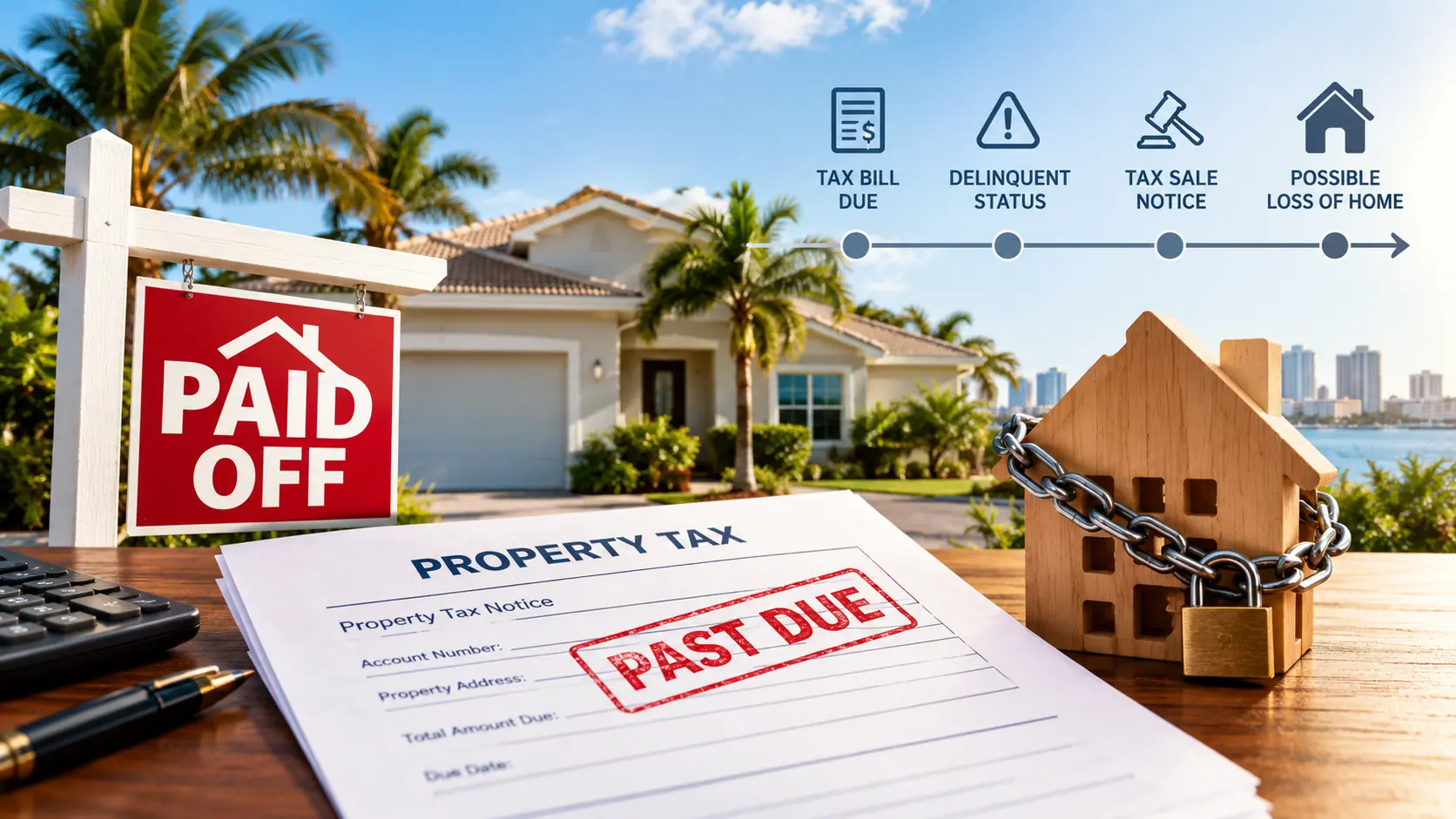
He owed four thousand one hundred dollars.The house was worth three hundred and ten thousand, paid off in 2016, his mother’s house before it was his. No mortgage, no credit cards, no judgments. Just three years of property taxes he had been meaning to deal with.A man he has never met owned the certificate on it and had applied for a tax deed.
I’m Kady. I help Florida homeowners through foreclosure, hardship, inherited property, illness, divorce, and all the rest of it. I am a Realtor with Momentum Realty and I buy houses, and this is the article I most wanted on my site, because this is the version of losing a home that almost nobody sees coming.
When you are behind on a mortgage, you get phone calls. Letters. A servicer with a loss mitigation department that is required by federal rules to review you for options. It is frightening but it is loud.
Property taxes are quiet. The bill comes in November and if you do not pay it, almost nothing happens that feels like an emergency. There is a newspaper advertisement you will never read. There is an auction you will not attend, where somebody buys a certificate on your debt. And then roughly two years later the real deadline arrives, and by then a stranger has the right to apply for a deed to your house.
The people this happens to are overwhelmingly the people with the most to lose. Retirees. Heirs who inherited a house and did not realise the bill was in somebody else’s name. Owners with no mortgage, which means no escrow account quietly paying it for them. People who are, on paper, debt free.
So here is the whole calendar, every exit along it, and exactly how much time you really have.
Florida property tax bills arrive around 1 November, with a 4 percent discount for paying in November that steps down to nothing by March, and the bill is due in full by 31 March. Unpaid taxes become delinquent on 1 April. They are advertised in a local newspaper in May, and the tax collector sells a tax certificate on your debt at auction on or before 1 June. The certificate holder does not own your house. They own the debt, and they earn interest while you do not pay. The real deadline is this: under Florida Statutes 197.502, the certificate holder may apply for a tax deed once two years have elapsed since 1 April of the year the certificate was issued. You can redeem at any point before the deed is issued by paying the tax collector in full. And if your property is homestead, the opening bid at a tax deed sale includes an extra amount equal to one half of the latest assessed value, which protects you in a way most owners have never heard of.
- Pay in November and save 4 percent. It is the only free money in this entire process.
- 1 April is when it turns serious. Delinquency, then advertising, then the certificate sale.
- A certificate holder does not own your house. They own the debt, and you can still redeem.
- Two years from 1 April of the certificate year is the deadline that actually matters.
- The installment plan has an April 30 deadline for the following year, and almost nobody uses it.
- You can redeem at any point before the deed issues. Until that moment, the house is still yours.
01The Full Calendar, Month By Month
Print this out and stick it on the refrigerator. This is the entire thing, and the reason I am giving it to you as a table is that every single row is a date somebody missed.
| When | What happens | What you can do |
|---|---|---|
| August | Your TRIM notice arrives, showing proposed assessed value, exemptions and estimated taxes | This is your window to question the assessment or a missing exemption. Read it |
| Around 1 November | The actual tax bill is mailed | Pay now for the 4 percent discount |
| December | Still payable | 3 percent discount |
| January | Still payable | 2 percent discount |
| February | Still payable | 1 percent discount |
| March | No discount. Due in full by 31 March | Last month to pay without penalty. Also: apply for a deferral if you qualify |
| 1 April | Taxes become delinquent. Interest and costs begin | Pay. Every day from here costs more |
| 30 April | Deadline to apply for next year’s quarterly installment plan | If this year hurt, apply now so next year does not |
| May | Delinquent real estate accounts are advertised in a local newspaper, three times | Redeem before the certificate sale and you avoid the whole certificate layer |
| On or before 1 June | Tax certificate sale. Investors bid on the right to your debt | You can still redeem at any time afterwards |
| 2 years after 1 April of the certificate year | The certificate holder may apply for a tax deed | Redeem before the deed is issued. This is the real cliff |
| After application | The Clerk of Court schedules a public sale and gives notice | Redeem, or if the sale happens, claim any surplus |
Now look at the shape of that. From a missed November bill to a tax deed sale is roughly two and a half to three years. That is a great deal of time, which is precisely the problem, because nothing in the middle of it feels urgent enough to act on.
The two rows I would tattoo on people are 30 April and two years from 1 April. The first one is the option almost nobody uses. The second one is the deadline almost nobody knows.
02What a Tax Certificate Actually Is
People hear that somebody bought their taxes at auction and assume the house is gone. It is not, and understanding what was actually sold will take a lot of the fear out of this.
When taxes go unpaid, the tax collector does not sell your house. It sells a tax certificate, which is a first lien for the unpaid amount plus interest and costs. The investor who buys it has paid your tax bill to the county. The county has its money. What the investor now owns is the right to be repaid, with interest, by you.
The auction works backwards from how most people imagine it. Bidding starts at 18 percent and bids down, with the certificate going to whoever accepts the lowest rate of return. On redemption there is generally a mandatory minimum of 5 percent for the certificate holder unless the winning bid was zero percent. So a well bid certificate on a decent property often ends up at a low single digit rate.
Here is what that means for you, and it is genuinely important. The certificate holder cannot evict you, cannot enter your property, cannot charge you rent, and does not own your home. They are a creditor holding a lien. You remain the owner with every right you had before, and you can pay them off through the tax collector at any time.
Most certificates are redeemed and never become anything else. The clerks’ offices will tell you that most properties advertised for a tax deed sale get redeemed before the auction. The certificate is the warning stage, not the ending.
What you should not do is relax because of that. The certificate is not the danger. The application for a tax deed is the danger, and that is a clock the certificate holder controls.
03The Real Deadline: Two Years From 1 April
This is the single most useful fact on this page and almost no homeowner knows it.
Florida Statutes section 197.502 provides that a certificate holder may apply for a tax deed after two years have elapsed since 1 April of the year the certificate was issued. Note how that is measured. Not two years from when you missed the bill. Not two years from the auction. Two years from 1 April of the year the certificate was issued, and the window to apply stays open until the certificate is cancelled.
So work out your own date. Find out which tax year is unpaid, add one year to get the year the certificate was issued, take 1 April of that year, and add two years. That is approximately when a stranger becomes able to start the process that ends in a sale.
And then understand what follows the application, because there is still road left even at that point. Once the holder applies, the Clerk of Court takes over. The clerk sets an opening bid, gives notice to interested parties, and schedules a public sale. That whole process takes months, and you can redeem the entire time, right up until the tax deed is issued.
I have had people call me at this stage convinced it was finished. It was not finished. In one case we had nine weeks, which was enough to arrange a sale with equity intact rather than watch the house go at auction.
04The Homestead Protection Nobody Mentions
There is a provision in the tax deed rules that works quietly in favour of Florida homeowners and almost nobody writes about it.
At a tax deed sale, the clerk sets an opening bid. For an ordinary property that bid covers the unpaid taxes and interest, the tax collector’s fees, and the clerk’s administrative costs and expenditures required to bring the property to sale. A modest number, often just a few thousand dollars.
For homestead property, something is added. The opening bid also includes an amount equal to one half of the latest assessed value from the tax roll.
Think about what that does. On a homestead assessed at $240,000, an opening bid that would otherwise have been around $6,000 becomes roughly $126,000. Which means two things, both of them good for you.
It makes a cheap grab at your house much harder, because nobody is picking up a homestead for the price of the back taxes. And if the sale does happen and somebody bids, there is a substantial sum above what is owed, and that money does not belong to the county or the bidder. It is surplus, and you may be able to claim it.
So if you have a homestead exemption on the property, you are in a materially better position than an owner of a rental or a vacant lot in the same situation. And if you should have a homestead exemption and do not, perhaps because the house was inherited and the exemption was never reapplied for, that is worth fixing with your property appraiser quite apart from the tax debt, because it affects both your annual bill and this protection.
I am telling you about the homestead opening bid so you understand your position, not so you can relax into it. It raises the price of taking your house. It does not stop the sale, it does not stop the interest, and it does not stop the fees. Owners who hear this and decide they have breathing room are the ones who end up claiming surplus funds instead of keeping a house. The protection is a cushion under a fall, not a reason to stay near the edge.
05Redemption, and How To Do It
Redemption is the word for paying the whole thing off and making it go away, and it is simpler than people fear.
You redeem through the county tax collector, not through the certificate holder, not through the Clerk of Court, and not through whoever has written you a letter. This matters, because people in this situation receive a great deal of mail from companies who want to buy their house or “help” with their taxes, and some of it is designed to look official.
Three practical points.
Call the tax collector and ask for the exact redemption amount in writing. It changes over time as interest and fees accrue, so you want a figure good through a specific date. Ask them to confirm which tax years are outstanding, which certificates exist, and whether a tax deed application has been filed. That last question is the one that tells you how much time you have.
You can redeem right up until the tax deed is issued. Not until the application. Not until the sale is advertised. Until the deed issues. If someone tells you it is too late, verify that with the tax collector or the clerk directly.
A mortgage holder can also redeem, and frequently does, because a tax lien sits ahead of a mortgage and no lender wants to be wiped out by a tax deed. If you have a mortgage and unpaid taxes, there is a reasonable chance your servicer will pay the taxes to protect its position and then add the cost to your loan, usually through escrow. That is not generosity and it will raise your monthly payment, but it does remove the tax deed risk. I have written about what that kind of escrow increase does to a payment in your insurance got cancelled and your mortgage payment jumped, because the mechanics are the same.
06Your Five Ways Out, Cheapest First
Pay in November
A 4 percent discount for paying the month the bill arrives, stepping down through 3, 2 and 1 percent to nothing in March. On a $4,000 bill that is $160 for doing in November what you were going to do in February anyway. If cash flow is the problem rather than the amount, this is still the cheapest version of the bill you will ever be offered.
The quarterly installment plan
Florida counties offer a four payment installment plan, and you apply by 30 April for the following year. The payments fall across the year with discounts on the earlier ones, typically around 6 percent on the first, 4.5 percent on the second and 3 percent on the third, with none on the last. This is the single most underused tool in Florida property tax, and for anybody on a fixed income it turns one impossible bill into four manageable ones. Confirm the schedule with your county tax collector.
Homestead tax deferral
Florida allows qualifying homestead owners to defer part or all of the tax bill, which creates a lien rather than a demand. It is particularly aimed at older owners and lower household incomes. It is not forgiveness, and there are limits that disqualify people, but it buys real time. I have written the whole thing up in what is Form DR-570, including the limits that get applications denied.
Borrow against the house or from family
If you have equity and some income, a home equity line or a personal loan at a real interest rate is very often cheaper than letting a certificate run and fees accumulate, and far cheaper than losing the house. Run the comparison honestly rather than deciding borrowing is out of the question. Be careful with anyone marketing a “tax lien loan” to delinquent owners, and compare their terms against a credit union before you sign.
Sell, on your terms, before the deed issues
If the bill cannot be paid and the income is not coming back, selling while you still own the house is how you keep the difference between what you owe and what it is worth. On a $310,000 house with $4,100 of taxes, that difference is almost all of it. List it with a Realtor if you have time, or sell as is for cash if you do not. What you must not do is let it run to a sale and hope for surplus funds.
07If You Inherited The House
A disproportionate number of the tax deed cases I see involve inherited property, and it is almost always the same story, so let me name it.
Mum passes away. The house is paid off. Nobody probates it immediately, or probate is opened and moves slowly, and in the meantime the tax bill continues to be issued in her name, to an address nobody is checking, for a house the family thinks of as safe because there is no mortgage on it.
Three years later somebody opens a letter.
Four things if that is you.
Find out what is actually owed, today. Ring the county tax collector with the parcel number and ask which years are unpaid, which certificates exist, and whether any tax deed application has been filed. You do not need to be on the deed to ask what is owed on a parcel.
Check the exemptions. The homestead exemption does not survive the owner, and neither does the Save Our Homes cap, which means the assessed value can jump substantially after a death. A great many families are shocked by the size of the bill because of this, not because anybody did anything wrong. If an heir lives there as their permanent residence, they may be able to apply for their own exemption.
Understand that redeeming does not settle who owns it. Paying the taxes protects the asset. It does not transfer title, and if several siblings are involved, the one who pays needs an agreement in writing about how that is accounted for later. I have seen families lose more to that argument than to the tax bill.
Do not let probate speed set the deadline. The tax deed clock does not pause for an estate. If the probate will take nine months and the deed application window opens in three, the taxes need handling now, separately, by whoever can do it.
I have written more on the whole inherited property question in inherited a house in Florida, here is what to do first, and if the plan is to prevent this for the next generation rather than to fix it for this one, that is worth reading too.
08Surplus Funds, and Why They Matter
I want to explain this properly, and then tell you why I hope you never need it.
If a tax deed sale happens and the property sells for more than the opening bid, the extra money is surplus. The Clerk of Court holds it. Government liens get paid where applicable, notices go out to interested parties, and there is a claim period during which parties including the former owner can claim according to priority. Unclaimed funds are eventually transferred to the State of Florida.
So on a homestead where the opening bid included half the assessed value and the property sold above it, there can be a meaningful sum sitting with the clerk that belongs to the former owner.
Two warnings.
First, there is an industry of people who track tax deed sales and contact former owners offering to recover surplus funds for a cut. Some are legitimate. Some charge a great deal for filing a form you could file yourself. Ask the Clerk of Court in the county where the sale happened what the claim process is before you sign anything with anybody.
Second, and this is the real point. Surplus funds are always worse than selling. Always. At a tax deed sale you have no control over the price, the costs come out first, the timing is not yours, and the house is gone. If you sell the same property yourself you set the price, you choose the closing date, and you keep far more of the equity. In the $310,000 example, selling yourself might net two hundred and eighty thousand. Hoping for surplus might net a fraction of that, months later, after a claim process.
If you are anywhere near the deed stage, selling beats waiting. Every time.
What people believe
My house is paid off, so nobody can take it.
What is true
A tax lien sits ahead of everything. No mortgage means no escrow account quietly paying the bill for you, which makes you more exposed, not less.
What people believe
Somebody bought my taxes at auction, so the house is already theirs.
What is true
They bought a lien, not your home. You are still the owner and you can redeem through the tax collector at any time before a deed issues.
What people believe
Once a sale is scheduled it is over and there is nothing left to do.
What is true
You can redeem until the tax deed is issued, and the clerk’s process takes months. I have seen nine weeks be enough to save the equity.
The man with the $4,100 bill and the $310,000 house did not lose it.
We rang the tax collector together and got the exact redemption figure and the status of the application. There was time. Not a lot, but enough.
He borrowed from a credit union against the house, cleared the whole thing, and then set up the quarterly installment plan so that it never happens again. He still lives there.
Four thousand one hundred dollars. That is what was standing between him and a house his mother bought in 1979. I think about that one a lot.
Once your name appears on a delinquent list, the mail starts. Companies wanting to buy the house, companies offering to “settle” the taxes, companies warning you that time is running out in language designed to look like it came from the county. Some are legitimate businesses, mine included. Some are not. Three rules. Verify everything with the county tax collector or the Clerk of Court, who will talk to you for free and have no interest in the outcome. Never sign a deed, an option, or anything that transfers an interest in your property without a Florida attorney reading it first. And be suspicious of urgency, because the one genuine deadline here is a date you can confirm in a two minute phone call.
Tell me the county and roughly which years are unpaid and I will help you work out where you are on that calendar. Even if what you need is a credit union and not me.
07Questions People Ask Me
How long before you lose your house for unpaid property taxes in Florida?
Roughly two and a half to three years from the missed bill, and the key date is set by Florida Statutes section 197.502: a tax certificate holder may apply for a tax deed once two years have elapsed since 1 April of the year the certificate was issued. Taxes become delinquent on 1 April, the certificate is sold on or before 1 June, and the two year clock runs from 1 April of that issuance year. After the application the Clerk of Court’s process takes further months, and you can redeem at any point before the tax deed is issued.
What happens if I do not pay my property taxes in Florida?
Your bill arrives around 1 November and is due in full by 31 March. On 1 April it becomes delinquent and interest and costs begin. In May the delinquent account is advertised in a local newspaper. On or before 1 June the tax collector sells a tax certificate on your debt at auction. Two years after 1 April of the year that certificate was issued, the holder may apply for a tax deed, and the Clerk of Court then schedules a public sale.
Can someone buy my house for the back taxes?
Not directly, and not for just the taxes if it is your homestead. What an investor buys at the certificate sale is a lien, not your house. If it later goes to a tax deed sale, the clerk sets an opening bid covering the taxes, interest and fees, and for homestead property that opening bid also includes an amount equal to one half of the latest assessed value. That makes a cheap grab at a homestead very difficult. For non homestead property, the opening bid can be low.
What is the difference between a tax certificate and a tax deed?
A tax certificate is a lien for the unpaid taxes plus interest, sold at auction to an investor who has effectively paid your bill to the county. The holder is a creditor. They cannot evict you, enter your property, charge you rent, or claim ownership. A tax deed is the instrument that actually transfers the property after a clerk’s sale, and it only becomes possible once the certificate holder applies, which they can do two years after 1 April of the year of issuance.
How do I redeem a tax certificate?
Through your county tax collector, not through the certificate holder and not through anyone who writes to you. Call them with your parcel number and ask for the exact redemption amount in writing, good through a stated date, along with which tax years are outstanding, which certificates exist, and whether a tax deed application has been filed. That last question tells you how much time you have. You can redeem at any point before the tax deed is issued.
When do Florida property taxes become delinquent?
On 1 April. Bills are mailed around 1 November, with a 4 percent discount in November, 3 percent in December, 2 percent in January and 1 percent in February. March carries no discount and the bill is due in full by 31 March. From 1 April the taxes are delinquent and interest and costs start running, which leads to advertising in May and the certificate sale on or before 1 June.
Can I pay Florida property taxes in installments?
Yes, and hardly anybody does. Florida counties offer a four payment plan for which you apply by 30 April for the following tax year. Payments fall across the year with discounts on the earlier installments, commonly around 6 percent on the first, 4.5 percent on the second and 3 percent on the third, with none on the final one. For anyone on a fixed income this is the single most useful tool available, because it converts one large annual bill into four manageable ones. Confirm the exact schedule with your county tax collector.
Is there any way to delay paying property taxes in Florida?
Yes, for qualifying homestead owners there is a homestead tax deferral, filed with the county tax collector, which lets you defer part or all of the bill. It creates a lien on the property rather than forgiving the tax, it has an annual filing requirement, and there are limits based on age, household income, and how much is already owed against the property that cause applications to be denied. The deadlines and those limits are worth understanding before you rely on it.
What happens to the extra money if my house sells at a tax deed sale?
If the sale brings more than the opening bid, the Clerk of Court holds the overbid as surplus. Government liens are paid where applicable, notices go to interested parties, and there is a claim period in which parties including the former owner may claim according to priority. Unclaimed funds are eventually transferred to the State of Florida. Ask the clerk in that county directly what their claim process is before paying anybody a percentage to do it for you.
Should I wait for surplus funds instead of selling?
No, and I would say that even though selling is what I do for a living. At a tax deed sale you control nothing: not the price, not the timing, and the costs come out first. If you sell the property yourself you set the price, you pick the closing date, and you keep far more of the equity. Surplus funds are what is left over after you have lost the house. Selling is what happens while you still own it.
I inherited the house and the taxes were never paid. What do I do?
Call the county tax collector with the parcel number today and find out which years are unpaid and whether a tax deed application has been filed. You do not have to be on the deed to ask what is owed. Then check the exemptions, because the homestead exemption and the Save Our Homes cap do not survive the previous owner, which is why inherited tax bills are often far larger than the family expects. And do not let probate timing set your deadline, because the tax deed clock does not pause for an estate.
Will my mortgage company pay the taxes if I do not?
Frequently yes, because a tax lien sits ahead of a mortgage and no lender wants to be wiped out by a tax deed. Your servicer may pay the delinquent taxes to protect its position and then recover the cost from you, usually by recalculating your escrow, which can raise your monthly payment substantially. That removes the tax deed risk and creates a mortgage affordability problem instead. It is better than losing the house, and it is worth understanding before it happens.
Does a tax lien wipe out my mortgage?
A tax deed sale can extinguish many interests in the property, which is exactly why mortgage holders redeem to protect themselves. Do not take comfort in that. The question of what survives a tax deed is genuinely complicated, varies with the specific lien and how notice was given, and is an attorney’s question rather than a blog’s. What matters for you as the owner is simpler: whatever happens to the mortgage, you lose the house and the equity.
I keep getting letters about my back taxes. Are they legitimate?
Some are and some are not, and the way to tell is to stop reading them and start calling the county. Your tax collector and your Clerk of Court will tell you your real status for free and have no stake in the outcome. Never sign a deed, an option, or anything transferring an interest in your property without a Florida attorney reading it first. And treat manufactured urgency as a warning sign, because the one real deadline here is a date you can confirm in a two minute phone call.
Can I appeal my property taxes if the bill is too high?
You can challenge the assessment, but the time to do it is when the TRIM notice arrives in August rather than when the bill arrives in November. The TRIM notice shows the proposed assessed value, your exemptions and the estimated taxes, and it explains the petition process and deadline for your county. Also check that every exemption you are entitled to is actually applied, because a missing homestead exemption is a far more common cause of a shocking bill than an inflated valuation.
Keep reading
A gentle note: I am a Florida Realtor with Momentum Realty and a home buyer, not an attorney, an accountant, or a tax professional, and this is general information rather than advice about your property or your tax bill. Property taxes in Florida are administered county by county, so discount schedules, installment plan mechanics and filing procedures should always be confirmed with your own county tax collector and Clerk of Court. Statutory references here reflect publicly available information as of October 2026, including Florida Statutes chapter 197 and section 197.502. Please verify your own status directly with your county tax collector, and speak with a licensed Florida attorney before signing anything that affects title to your property.
Written by Kady Andreoli, founder of Helping Hand Home Solutions FL and a Realtor with Momentum Realty. Helping Florida homeowners explore every available option, from stopping foreclosure to selling on their own terms. Guidance without judgment, and people before profit. 904-400-2131 · kady@helpinghandhomesfl.com